
I was thinking about…
The Forgotten Classroom: How Gen Xers Learned Without the Internet
by Andy Lee
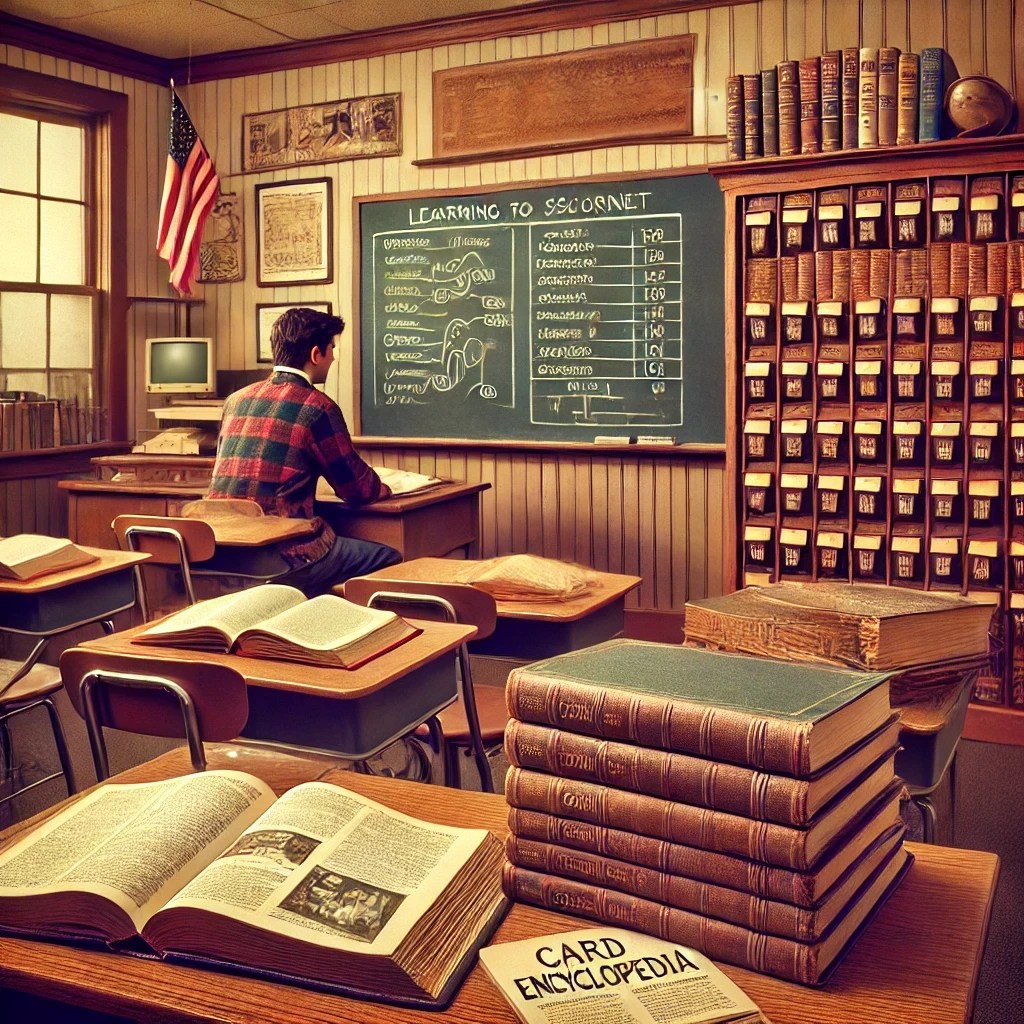
Picture this: a classroom filled with wooden desks, each one slightly scarred by the doodles of bored students. A chalkboard at the front of the room, dusted with a haze of white from the last lesson’s notes. And on every desk, a stack of textbooks. They are heavy and well-worn. Their pages are dog-eared and filled with the scent of years gone by. No tablets, no smartphones, and definitely no Wi-Fi. This was the world we Gen Xers grew up in—a world where learning meant something entirely different from today.
Before Google became our go-to guru, we had the Encyclopedia Britannica. It was a 30-volume behemoth that claimed an entire bookshelf in the family room. If you needed to know something, you didn’t just type a question into a search bar. You didn’t get answers in milliseconds. No, you had to flip through page after page, cross-reference entries, and sometimes come up empty-handed. Research was a process, and it taught us patience, persistence, and the value of a well-organized index.
Libraries were our sanctuaries, the silent halls lined with row upon row of knowledge waiting to be uncovered. The card catalog was our guide. It was a long wooden drawer filled with index cards. These cards listed every book by title, author, and subject. You learned to navigate the Dewey Decimal System like a pro. You became familiar with the layout of the library. You searched for that elusive book on medieval history or the life cycle of frogs.
But it wasn’t just about finding the information; it was about understanding it. When you had to summarize a chapter from your textbook or write a paper, there was no shortcut. You couldn’t copy and paste a Wikipedia entry (because, well, there was no Wikipedia). You had to read, comprehend, and then synthesize the material into your own words. It was a hands-on approach to learning that required critical thinking and creativity.
And let’s not forget about group projects. Without the luxury of online collaboration tools, we had to coordinate everything in person or over the phone. Do you remember making those phone calls to your classmates? We often prayed their parents didn’t pick up so we could get straight to the point. We met in living rooms and libraries, spreading out textbooks and notebooks on coffee tables, and figuring things out together. The lack of instant answers forced us to discuss, debate, and brainstorm. This process honed our communication and teamwork skills.
There’s something to be said for this analog way of learning. It made us more resourceful. When the answer wasn’t readily available, we learned how to dig deeper, to question, and to think critically about the information we did find. And perhaps most importantly, it taught us patience in an age where instant gratification was not an option.
Today’s students have the world at their fingertips. While that’s undeniably powerful, it’s worth remembering the unique skills we developed in those forgotten classrooms. We learned how to be self-reliant. We learned how to solve problems without relying on a screen. We learned how to appreciate the process of learning as much as the knowledge itself.
So the next time you see a dusty set of encyclopedias or pass by a library, take a moment to reflect on how far we’ve come. Consider what we have left behind in the rush to get here.
Stay curious, keep learning. 📚

 I was thinking about...