
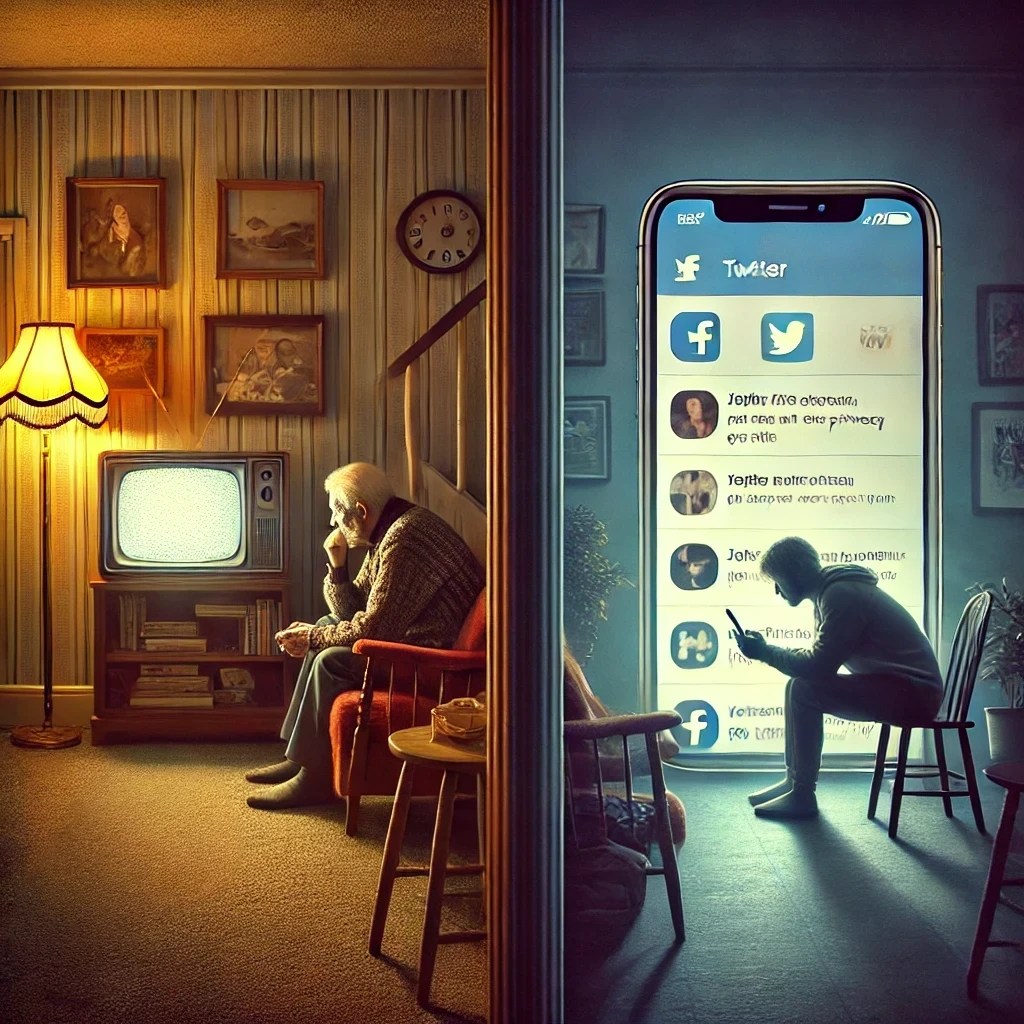
I was thinking about…
The Importance of Privacy for Gen Xers and Oversharing Culture
by Andy Lee
It seems like everywhere you turn these days, someone’s broadcasting their life on social media. From breakfast plates to bedtime routines, there’s a constant stream of personal information flowing out into the digital ether. As a Gen Xer, I can’t help but wonder: how did we get here? And more importantly, why do so many of us from my generation feel uneasy about this tidal wave of oversharing?
Growing up in the ’70s and ’80s, privacy was something we held dear—mainly because it was often all we had. We were the original latchkey kids, entrusted with our own keys and the responsibility of getting ourselves home after school. Our parents were often at work, and we were left to our own devices (and I’m not talking about smartphones). There was no one to check in on us. No one was there to snap a quick pic of our after-school snack for Instagram. We learned to value our solitude and the private moments that were just ours.
Fast forward to today, and the world seems to operate on a different wavelength. Social media platforms thrive on oversharing. It’s become almost second nature for people to document every aspect of their lives—from the mundane to the deeply personal. For Gen Xers, this constant exposure can feel like an intrusion. We’ve always had a bit of a rebellious streak. Maybe part of that rebellion is against the idea that every moment needs to be shared, liked, or commented on.
But why is privacy so important to us? For one, it’s about control. In a world where so much is out of our hands, we cherish being able to choose what we share. This ability is a form of autonomy. This choice gives us a sense of control. Deciding what we keep to ourselves is also a form of autonomy. It’s a way of protecting our inner worlds from the judgment and scrutiny of others. Back in the day, if you had a bad day at school, only your close friends knew about it. Now, it’s all too easy for those moments to become public property. They can be dissected and analyzed by anyone with a Wi-Fi connection.
Another reason is trust—or rather, the lack of it. We’ve seen what happens when privacy is breached, when personal information is leaked or sold. We know the risks of putting too much out there. We’re cautious about who we let into our digital lives. Trust was something that had to be earned, not freely given away with the click of a button. In a way, our reluctance to overshare is a protective mechanism. It is a way to keep the important things close to the vest.
And let’s not forget the value of mystery. There’s something to be said for not putting everything on display, for keeping certain aspects of our lives private. It’s not about hiding—it’s about preserving the sacredness of certain experiences. When you don’t share everything, the moments you do choose to reveal take on greater meaning. They’re not just part of the noise; they’re deliberate, intentional, and worth paying attention to.
The younger generations may embrace the transparency that comes with oversharing. However, many of us in Gen X will continue to hold privacy in high regard. It’s a part of who we are. It’s shaped by the experiences of our youth. It’s reinforced by the world we see around us today. We’re not anti-technology or anti-social media—we just prefer to keep some things out of the spotlight.
In the end, privacy is a choice. In this age of oversharing, it’s one that more of us might want to consider. After all, some things are still worth keeping to ourselves.
Stay private, keep it real. ✌️

 I was thinking about...