
I was thinking about…
The 1910 Wellington Avalanche and America’s Worst Avalanche You’ve Never Heard About
By Andy Lee
In the pre-dawn blackness of March 1, 1910 as rain drenched the Cascade Mountains, unassuming residents of Wellington station nestled along Stevens Pass slept soundly, unaware hell barreling towards them through Windy Pass at speeds topping 125 miles per hour.
In the preceding week, bitter blizzards smothered the region under several feet of heavy snow – nearly one foot accumulating hourly. On the worst day, nearly 11 feet of snow fell. Temperatures hovered below zero exacerbating conditions. Rumblings echoed down the mountain all afternoon on February 28th, but officials took little heed beyond halting inbound trains until the next morning.
There was no precedent for the horror those tense hours held.
Moments before 1 a.m. warm winds, heavy rain, lightning streaked, and terrifying thunder shook mountains to the core. The accompanying crack and groan deafened as the entire north face of Windy Mountain dangerously overloaded by recent deposits suddenly fractured then violently slid away. A ten foot hight mass of dense snow, half a mile long and a quarter of a mile wide broke loose and gained momentum crushing everything in its path through the ravine and across three miles stretching down to Tye River Valley where the village sat unknowingly in the freeze-framed path of destruction.
The avalanche’s leading edge hit speeds of 125 mph, taking mere minutes to annihilate miles of forest and terrain toward Wellington, growing into a deadly tsunami of trees, boulders and debris trapped in crushing icy white. Station lights still burned peacefully as the first splintered pines pierced through them directly into the lobby at 1:42 where guests and citizens not knowing what hit them.
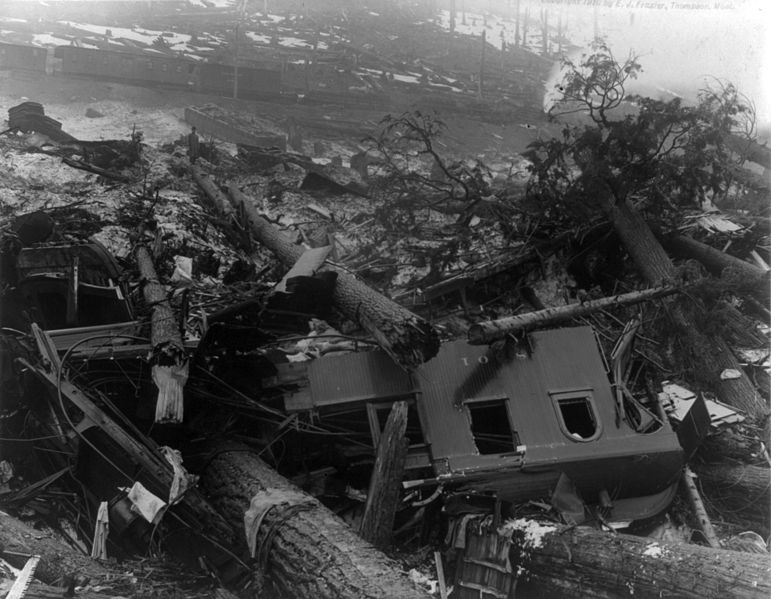
Two trains lay trapped at the station by conditions when impact drove their massive steel encasements along 150 feet of track before derailing down a 300 foot gorge into the Tye River, crushing occupants inside. Tragically because trains ran hours behind due to impassable routes from storms, many passengers slept in halls and spare depots offering shelter, multiplying victims.
Eerie silence followed save for nearby mountain rumbles still shifting. Stunned shock morphed into frenzied horror at daybreak revealing utter devastation in every direction. Crushed buildings…shattered trees…and too many lifeless bodies to immediately count. Rescue response lacked preparation for handling such mass calamity in a remote and rugged region where only train could deliver outside aid then eliminated by disaster itself.
Combing miles of wreckage would reveal officially 96 dead, although some estimates count over 120 perished taking into account trappers and hunters in the nearby mountains. Bodies remained entombed for 21 weeks in frozen chaos before warm spring sun freed the last corpse in late July to finally be laid to rest. Most victims perished by drowning or traumatic crushing rather than hypothermia during the extended live burial that still disturbs to fathom.
Reaction, understandably, shifted focus towards preventing repeats by engineering solutions over mourning losses. The newly minted U.S. Forest Service prioritized mapping and warning systems to monitor accumulations while Great Northern Railway Company constructed massive snow sheds over vulnerable stretches of the Mountain Loop.
The village was shortly thereafter renamed Tye to distance itself from association with tragedy. But despite those preventative efforts, many residents abandoned the precarious geography of the valley soon after to settle safer towns. The cursed ghost town would ironically face torching then in 1918, erasing all remaining traces of habitation.
These days only the abandoned train tracks and reinforced concrete sheds cutting through tranquil mountainside known now as the Iron Goat Trail still bear eerie witness far from tourist maps tracing back a century to the night America’s deadliest natural disaster buried an entire town alive.
Stay vigilant, keep watchful…🌨🚞⛺
 I was thinking about...