
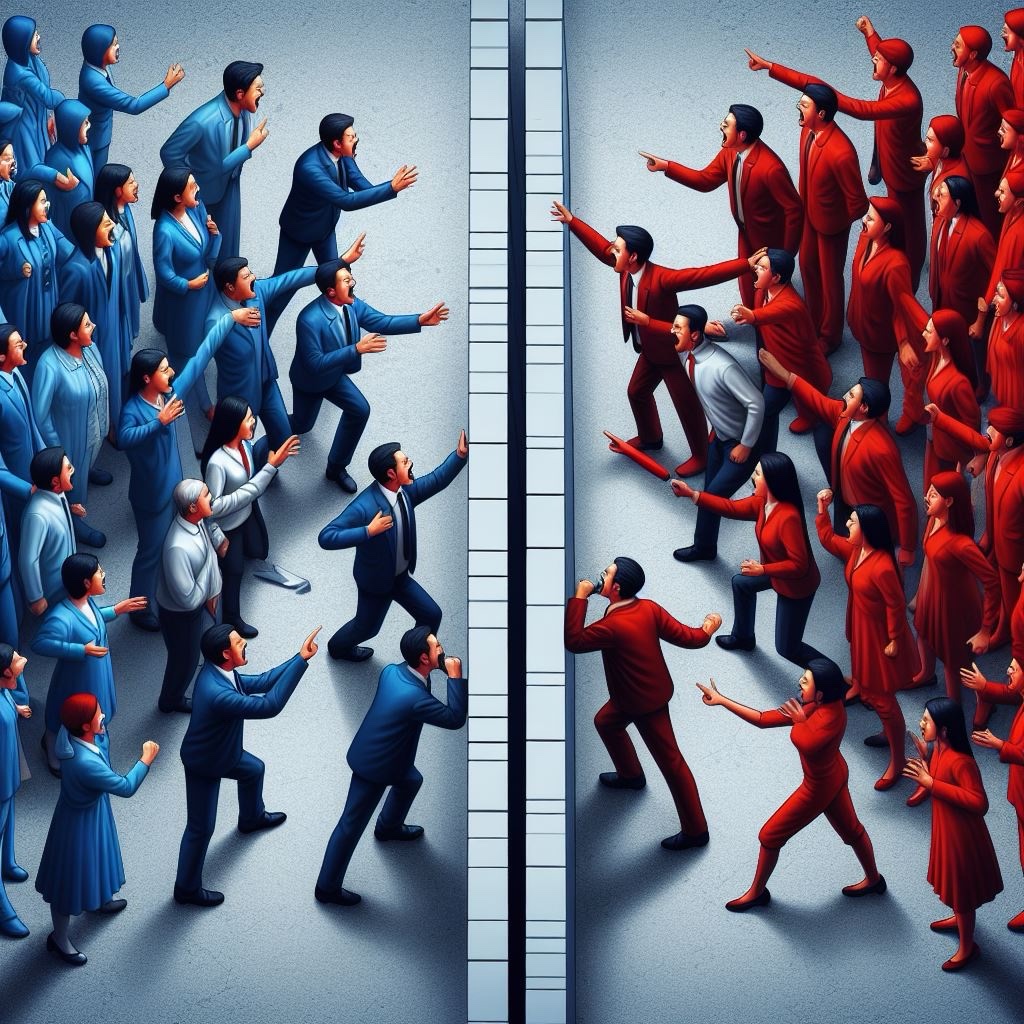
Today I’d like to discuss a rising issue that has me deeply troubled about the state of political discourse and polarization in America. More of an op-ed than my usual content, I feel compelled to speak openly about a phenomenon – ideological “echo chambers” and lack of perspective-taking across divides – that poses profound dangers to the health of our democracy and national unity if we don’t counteract it. What follows comes entirely from my personal perspective as a worried citizen watching civility, understanding and good faith communication erode rapidly. I hope these thoughts resonate beyond just those who already agree with me to spark self-reflection from Americans across the political spectrum about our shared duty to heal and defend democracy.
I was thinking about…Echo Chambers: The Dangers of Only Hearing What We Already Believe
By Andy Lee
An “echo chamber” refers to situations where people only consume information and ideas that conform to and reinforce their existing views. Inside an echo chamber, the same ideas are repeated and reinforced, while contrasting views are downplayed or ignored. This can apply to individuals as well as groups or communities.
But while it’s comforting to discuss ideas with the like-minded, it is equally if not more important to engage with those who think differently. I fondly remember when political disagreements didn’t have to damage relationships – when heated debates over the issues of the day could end with “Are you and your spouse still coming over for dinner on Saturday?” In today’s polarized climate, we often attack opposing views instead of understanding them. We conflate an opposing perspective with lack of character when in reality it stems from a complex mix of values and experiences.
If we hope to heal the divided nature of public discourse and policymaking today, we desperately need more civil dialogue across political and ideological spectra. This means making a concerted effort to expose ourselves more to alternate viewpoints and the honest reasoning behind them. We should choose at times to consume media that challenges our assumptions instead of just reinforcing our biases. We can engage acquaintances and even strangers with open-minded curiosity when differing views emerge instead of knee-jerk defensiveness.
Understanding where someone is coming from, why they see things differently even if we disagree, allows us to identify shared hopes and values amid opposing policy solutions. We can shift debate to be less about attacking character and more about resolving issues. With perspective-taking, compromise becomes possible again, pulling us back from the perilous brink of irreparable polarization and societal fracture. Reinvigorating qualities of empathy, humility and good faith in how citizens communicate across divides will protect the functioning of our democratic system.
We may never see truly eye-to-eye with those who start from vastly different worldviews, life journeys or values. But recalling our shared identity as citizens first can make working through issues together far more constructive. Our democracy depends now more than ever on rising above echo chambers – not just listening to different views, but making a genuine effort to understand them. This alone gives me hope that no issue is so intractable for the American people to solve together.
The path back from polarization and dysfunction begins with individuals having the courage to burst their own echo chambers. Of course we need the accountability of media platforms too. But media algorithms can only show us new perspectives – we have to choose to broaden our own. No law can force us to make understanding across divides a civic responsibility or rebuild lost trust. We must take these steps ourselves, pushing past discomfort towards empathy.
Our democracy has survived profound division in the past because enough citizens recognized holding it together matters more than winning on issues. We are the common inheritors of its blessings and ideals – that too makes us comrades of a kind. I still believe understanding and compromise are possible when we appeal to this spirit of shared citizenship and that progress follows where good faith leads. Though the hour is late, I thus remain hopeful about the power within each of us to either safeguard or reinvigorate our democracy. The choice about the society we leave the next generation all depends on the echo chambers we choose to build or tear down today.
 I was thinking about...