
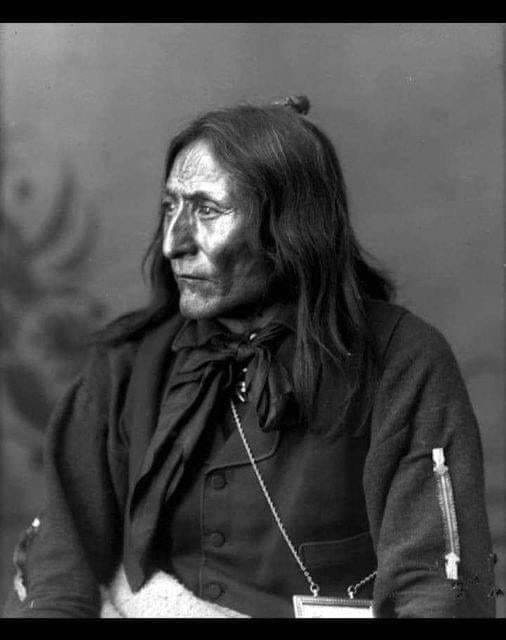
I Was Thinking About…Chief Crowfoot and the Sacred Trust of Land
By Andy Lee
The sweeping prairies and majestic peaks of the American West once sustained a rich diversity of Indigenous tribes, each with their own customs and spiritual ties to the land. But in the late 1800s, white settlers were rapidly expanding West in search of resources, sparking tensions with Native peoples.
This occurred during the Indian Wars, as the US government sought to forcibly remove tribes from their ancestral homelands. Indigenous people faced violence, deprivation of rights, and pressure to assimilate under damaging federal policies. Their very way of life was under threat.
It was within this fraught context that an encounter unfolded between the Blackfoot Confederacy and American envoys in the 1880s. The Blackfeet had long roamed the valleys and mountains of Montana, following bison herds and treasuring the land’s gifts. But the US sought their territory for homestead and mineral claims.
When American negotiators arrived urging Chief Crowfoot and other leaders to sign treaties ceding their lands, difficult discussions followed. Yet Crowfoot approached them with restraint and profound insights into the vastly different values underpinning the two cultures.
As talks commenced, the American chief unfurled dollar bills, explaining they could be exchanged for Blackfoot lands. Perplexed, Crowfoot took a handful of clay from the riverbank and molded it into a ball, placing it onto the fire. As all observed, the clay remained firm and unbroken amidst the flames.
Then he said to the white man, “Now put your money on the fire and see if it will last as long as the clay.” The white man said, “No….my money will burn because it is made of paper.”
With an amused gleam in his eyes the old chief said, “Oh, your money is not as good as our land, is it?”
To the Blackfoot, land meant far more than property or capital. It tied them to their ancestors through burial grounds and sacred sites. They relied on the buffalo, plants, and waterways to survive. Their language and stories reflected deep knowledge of the natural world after centuries of habitation.
To illustrate the vast wealth contained in even a tiny parcel of soil, Crowfoot grabbed a handful of sand and offered it to the settlers. “You count the grains of sand in that while I count the money you give for the land,” he proposed with a smile.
Acknowledging he could never count each grain, the American negotiator conceded Crowfoot could tally the dollar amount far faster. Nodding, the chief replied, “Our land is more valuable than your money. It will last forever. It will not perish as long as the sun shines and the water flows, and through all the years it will give life to men and animals.”
With piercing insight, Crowfoot explained, “We cannot sell the land because it does not really belong to us. It was put there by the Great Spirit and we cannot sell it because it does not really belong to us. You can count your money and burn it with a nod of a buffalo’s head, but only the Great Spirit can count the grains of sand and the blades of grass on these plains.” He knew the white men saw land as a commodity to be exploited, while for his people it held sacred, unquantifiable worth.
Resolute yet gracious, Crowfoot concluded, “As a present we will give you anything you can take with you, but we cannot give you the land.” Though pressured by the more powerful nation, he remained steadfast in his convictions, protecting the land for future generations.
Today, as climate change and reckless environmental destruction put the entire planet at risk, Crowfoot’s message resonates across centuries. Have we learned to value Earth’s irreplaceable bounty over fleeting material wealth? Do we honor ancestral wisdoms seeking balance between progress and preservation?
The land’s gifts of life and sustenance come with responsibility. Its timeless rhythms and unspoken wisdom humble our hubris. Chief Crowfoot was a visionary who spoke eternal truths in a changing world. May his courage and foresight inspire us to build an honorable legacy our descendants will be proud to inherit.
What can we learn from Indigenous peoples’ sacred connection and care for the land? How might Crowfoot’s convictions guide us in safeguarding our shared natural heritage? The future remains unwritten, but voices like Chief Crowfoot’s remind us – our greatest duty is as stewards protecting this earthly home for all our relations still to come.
For today, I was thinking of Chief Crowfoot, who understood earth’s gifts are not transactional but meant to uplift all beings. If we listen, the land itself teaches what endures.
Stay curious, keep exploring! 😊
 I was thinking about...