
I Was Thinking About…The Perpetual Motion Machine, Is It Possible?
By Andy Lee
The concept of a perpetual motion machine that runs forever on its own power has long fascinated inventors, engineers, and dreamers. But is such a wondrous self-sustaining device possible, or just wishful thinking that violates the laws of physics? Let’s explore the enduring allure of perpetual motion and whether science could one day unlock this technological holy grail.
The goal of a perpetual motion machine is to keep operating continuously without any external energy source. It would essentially be a mechanical system that, once started, would keep itself going forever. The machine would provide its own motive power, such as through gravity, magnets, or other internal mechanisms.
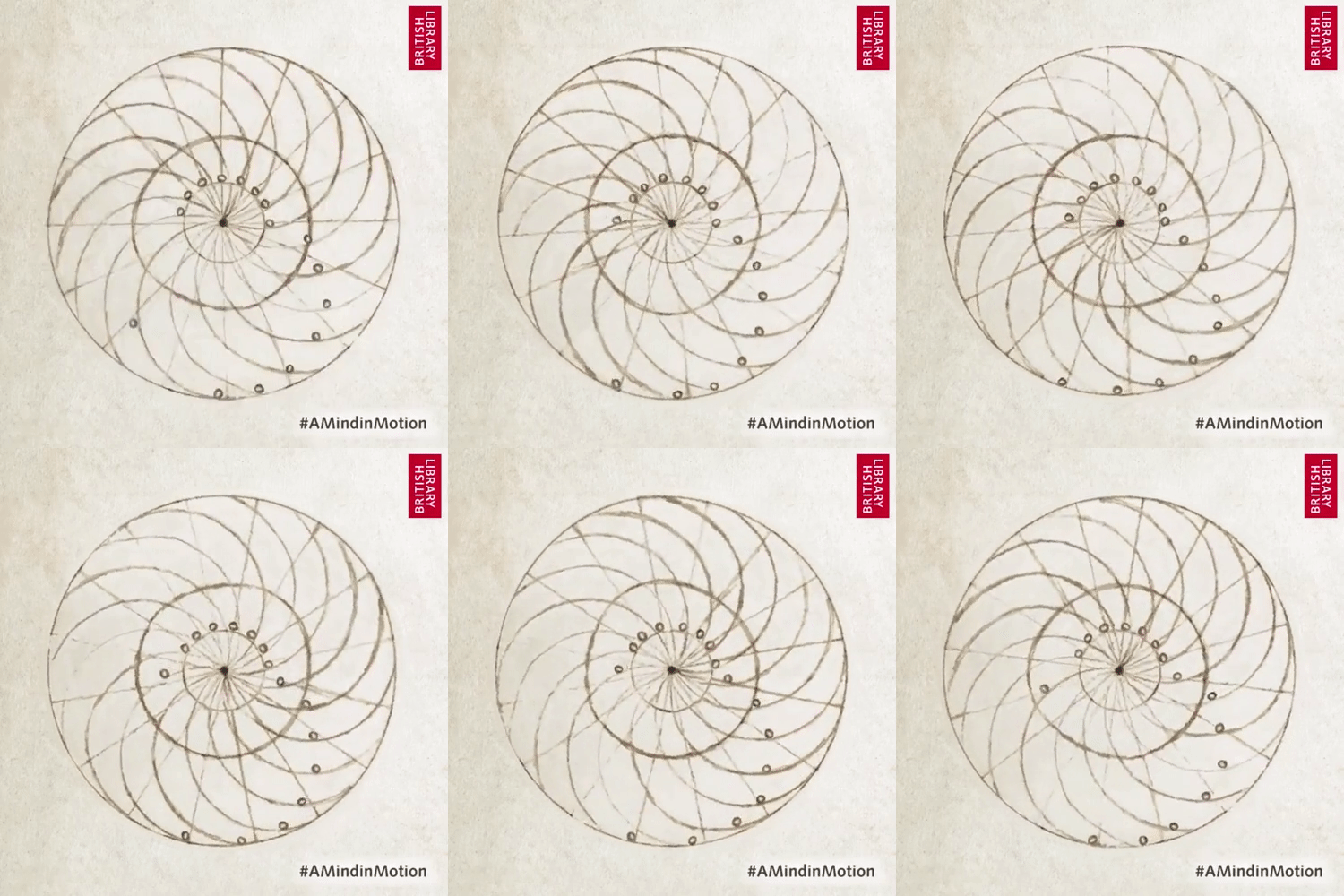
Through history, ingenious tinkerers have tried to conceive of designs for a perpetual motion device. Names like Johannes Kepler in the 1600s and Henry Dircks in the 1800s crop up in connection with idealistic attempts. But the fundamental laws of thermodynamics seem to doom the dream.
The first law states that energy can neither be created nor destroyed – it can only transform from one form to another. A machine cannot produce more energy than it takes in. The second law says that in any closed system, entropy increases over time. Some usable energy is always lost to heat, friction, and other inefficiencies.
Based on these principles, physicists generally accept that a true perpetual motion device is impossible. Even the best engineered machine still requires power input to overcome sources of degradation and energy dissipation. It cannot recycle or reuse 100% of mechanical energy endlessly.
Yet hope springs eternal for those determined to chase the phantom of perpetual motion. Over the centuries, hobbyists have drafted elaborate plans for gravity-powered wheels, magnetically levitating rings, and gyroscope-like wheels allegedly capable of unending rotation.
You can still find countless videos online claiming to show perpetual motion machines in action. But inevitably, a closer look reveals concealed power sources or mechanisms that violate well-established physical laws. Debunkers have replicated supposed perpetual motion devices using hidden wires, batteries, airflow, or electromagnetic conveyors.
One famous example was the invention of Ohio man Howard Johnston in the 1910s. His seemingly self-sustaining gizmo known as the “Johnston’s Motor” appeared in newspapers and magazines touted as a miraculous perpetual motion machine. But it was later exposed as completely fraudulent.
While true perpetual motion is impossible, scientists have achieved impressively long-lasting movement through creative engineering. In 2005, scientists designed a kinetic sculpture driven by thermal convection that rotated continuously for over 7 months.
Micro-machines using ultra-efficient bearings and energy recycling have operated maintenance-free for months as well. Superconducting rings with persistent electrical currents have sustained rotation for years with minimal energy loss. But inevitably some driving power source or bearing wear limits the motion.
Perhaps someday in the far future, revolutionary physics discoveries will shatter our current conceptions and make perpetual motion achievable. For now, the quest continues to build ever more efficient and long-lasting mechanisms that approximate the dream, even if perpetual motion remains elusive.
While true perpetual motion remains impossible, the relentless pursuit of this goal has pushed engineers and inventors toward increasingly sustainable and efficient energy solutions. For example, in their quest for ever-lasting operation, perpetual motion tinkerers have developed ultra-low friction bearings, efficient magnetic levitation, and creative recycling of mechanical energy – innovations that contribute to longer-lasting and lower energy modern machines. Even failed attempts contain lessons that lead scientists toward better understanding thermodynamics and finding new ways to minimize waste, friction, and degradation over time. Though no one has achieved the ultimate aim of infinite operation, striving after this dream has tangibly advanced power storage, renewable energy, robotics, and other technologies to become more self-sustaining.
The enduring appeal of perpetual motion speaks to our human aspirations. It captures the idea of boundless possibility, of limitless clean energy for all. We want to believe we can break free of physical limits through sheer ingenuity. But the universe imposes rules we have yet to circumvent when it comes to useful perpetual motion.
Rather than give up on realizing the impossible perpetual motion machine, the healthier perspective may be to ask: what good things can we create and sustain when we accept and understand physical limits, rather than deny them? The dream of perpetual motion can guide us toward making devices last longer, waste less, and serve human needs far into the future. Everything needs renewal eventually, but perhaps aspiring after the infinite can produce something that lasts.
Stay curious, keep exploring! 😊
 I was thinking about...