
I Was Thinking About…East Germany Opening the Berlin Wall
By Andy Lee
The Berlin Wall was more than just a physical barrier dividing a city. For 28 years, it stood as a symbol of the division and tensions of the Cold War era. Its sudden opening by East German authorities on November 9, 1989, stunned the world but also signaled the beginning of the end of the decades-long standoff between East and West.
The origins of the Berlin Wall date to the aftermath of World War II when vanquished Germany was split into occupation zones controlled by Allied forces. The eastern zone fell under Soviet domination as a communist state aligned with Moscow. In 1949, the western zones became the Federal Republic of Germany (West Germany) while the eastern zone was established as the German Democratic Republic (East Germany).
That same year, East German authorities began trying to stop the flow of citizens moving to the more prosperous West by closing off access between East and West Berlin. Barbed wire fences went up overnight, dividing streets and neighborhoods with a menacing barrier.
Over the next decade, an ever more elaborate and impenetrable boundary solidified around West Berlin. By 1961, East German leader Walter Ulbricht approved the construction of a 12-foot-high concrete wall reinforced with barbed wire and over 300 guard towers. The Berlin Wall became the physical representation of the Iron Curtain division between Eastern bloc and Western Europe during the Cold War.
Crossing the Berlin Wall was next to impossible. Heavily armed soldiers guarded the wall and would shoot at those trying to escape into West Berlin. Hundreds lost their lives over the decades trying to cross over to freedom.
The Berlin Wall came to symbolize the Soviet Union’s authoritarian control over its citizens. On the western side, public figures like Presidents Kennedy and Reagan gave dramatic speeches condemning the wall and imploring “Mr. Gorbachev, tear down this wall!”
But in the late 1980s, reformist Soviet leader Mikhail Gorbachev refused to clamp down as protests grew in East German cities like Dresden and Leipzig. This growing instability led the East German leadership to make a startling decision.
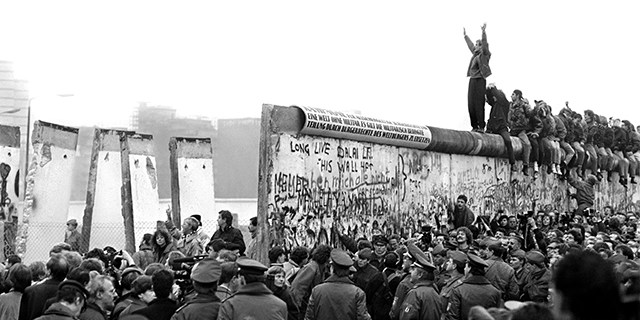
On November 9, 1989, East German party leader Guenther Schabowski made a surprise announcement that travel restrictions between East and West Germany would be lifted immediately. Huge crowds began gathering at the wall as guards stood unsure what to do. Finally, they relented and opened the gates.
Overjoyed German citizens flooded across makeshift checkpoints, chanting “Tor auf!” (Open the gate!) and embracing loved ones they hadn’t seen in decades. Televised images of people chipping away at the wall with chisels and sledgehammers flashed around the globe.
Within days, the once-formidable Berlin Wall was reduced to rubble as citizens tore it down. Fragments were scooped up as historic souvenirs. Where the wall once loomed ominously now stood open passages between the eastern and western halves of Berlin.
The breaching of the Berlin Wall signified the beginning of the end of East Germany’s hardline communist rule. Free elections were set for the following year, leading to the reunification of Germany as one nation under a democratic system in 1990.
The jubilant images from Berlin also demonstrated that the Soviet Union under Gorbachev would no longer intervene militarily to suppress dissent in satellite states. The Cold War status quo that had lasted since World War II was crumbling quickly now.
For the United States, the fall of the Berlin Wall provided confirmation that Gorbachev truly intended to reform the Soviet Union and normalize relations with the West. This pivotal event accelerated steps toward nuclear disarmament agreements and growing cooperation between the two superpowers.
The rapid collapse of communist rule across Eastern Europe followed, culminating in the breakup of the Soviet Union itself in 1991. Watching the Berlin Wall’s dismantling on TV, President Bush recognized a shifting tide that would soon transform the global geopolitical landscape.
Of course, ending decades of hostility and mistrust could not happen instantly. But the images from Berlin of families reunited signaled a profound change was underway. Hardliners would continue resisting reform, but the momentum was shifting toward peace and openness. A cycle of escalating conflict and brinksmanship had run its course.
While the Berlin Wall had stood as a stark reminder of ideological divisions and repression for 28 years, its dismantling triggered a new optimism. As one East Berliner described, “It was the greatest day of my life when the wall came down. The prison gates had finally opened!”
The grandest symbol of communist refusal to reform had fallen, allowing a united Germany to move ahead toward a democratic future. For people across Eastern Europe, the breaching of the mighty Berlin Wall meant awakening after decades of authoritarianism to reclaim their destinies. A new era of possibility was dawning.
Stay curious, keep exploring! 😊
 I was thinking about...