
I Was Thinking About…Ford’s Assembly Line
By Andy Lee
When I reflect on momentous innovations that shaped modern America, Henry Ford’s moving assembly line stands out. By revolutionizing automobile production, Ford utterly transformed 20th century manufacturing, consumerism, and even society itself.
Of course, Ford was not the sole inventor of mass production. Interchangeable parts and division of labor had been emerging for decades. But his vision perfected these concepts at scale to churn out affordable, identical Model T cars for eager consumers.
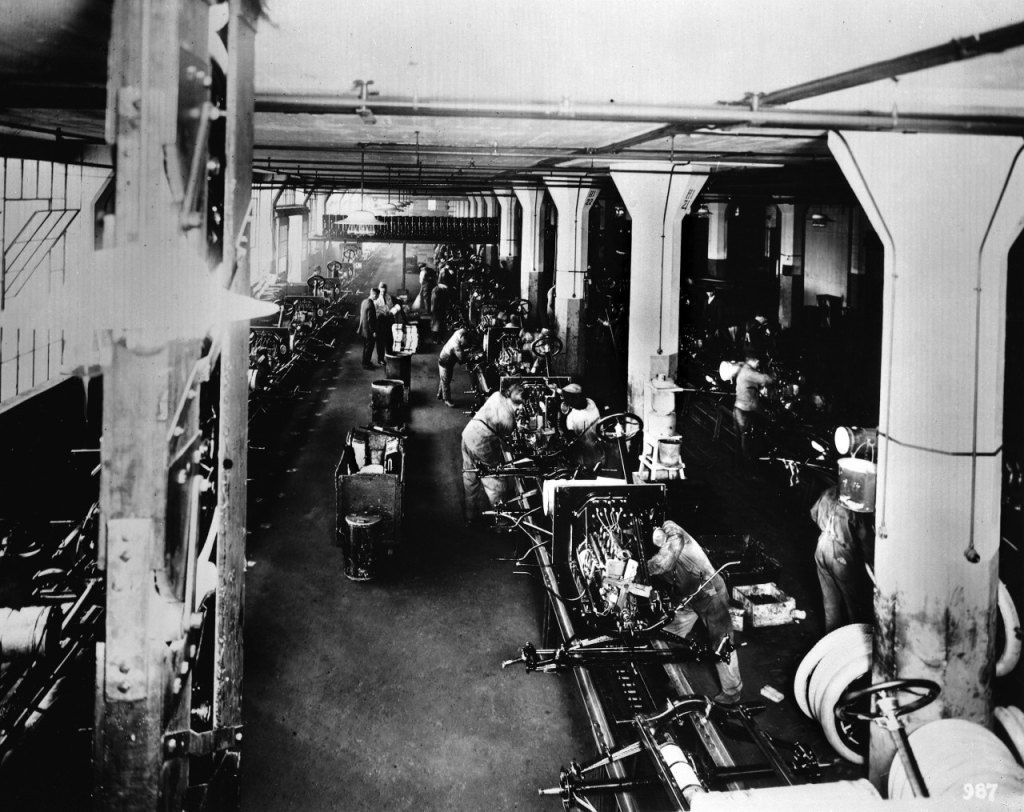
Ford’s ambitions took shape at his Highland Park plant, opened in 1910 just outside Detroit. Adopting conveyor belt technology from other industries, by 1913 he had developed a continuously moving assembly line. Workers stood in place completing the same small task as each chassis rolled past them.
This replaced individually hand-crafting entire vehicles. Component standardization and precision machining enabled fully interchangeable parts. The moving line allowed much faster assembly by eliminating wasted motion. In 1914, Ford produced over 300,000 cars – more than all other automakers combined.
The effects reverberated widely. Autos became affordable for average Americans, vastly expanding mobility, suburbanization, vacations, and freedom. The strenuous but rote line work paid well, especially as Ford adopted a radical $5 day wage in 1914. But many workers chafed at the monotonous hours performing mindless tasks.
Ford’s model inspired imitation and adaptation across sectors. Appliances, electronics, food processing, and more transitioned to mass production systems. Efficiencies lowered prices, permitting the rise of consumer culture. Supporting this output required improved infrastructure like highways and electricity grids.
Of course, mass production had societal downsides too. Work became repetitious, fast-paced, and dangerous. Products emphasized utility over aesthetics or customization. Advertising grew more pervasive, manipulating demand. Planned obsolescence and wastefulness increased as items became disposable.
Environmental and mental health costs accrued as well. Cities sprawled, open spaces shrank. The deprivation and pace of line work strained psyches. Critics like Charlie Chaplin parodied the dehumanizing nature of mechanized industry. Unions clashed with big business over working conditions and wages.
But Ford undeniably revolutionized manufacturing. His vision for scale, efficiency, standardization, and integration birthed an era of abundant consumer goods that changed day-to-day life. Of course, no one man innovates alone. Ford built upon existing technological and scientific advances. His ideas spread so widely because society was primed for them to take root.
As we design the systems that shape our world, we must balance productivity with humanity. The double-edged sword of industry can uplift living standards even as it risks much. Sensible regulation, corporate responsibility, and ethical innovation are needed to maximize benefits while minimizing harm.
Progress has always disrupted as much as improved. But with care, we can steer change toward justice. Perhaps the spirit of Ford’s assembly line – increasing access and opportunity – can be reclaimed by building a sustainable production and consumption future. Efficiency should serve humankind, not control us.
For today, I was thinking about Ford, whose assembly line ingeniously fed consumer appetites yet cautioned us about industry’s effects on body and soul. With conscious effort, we can still harness mechanization’s gifts while safeguarding what makes us human.
Stay curious, keep exploring. 😊
So many fascinating lives and events remain undiscovered – never stop searching for new perspectives on history. Subscribe below to have these forgotten stories from the past delivered directly to your inbox. It’s free. Unsubscribe at any time.
 I was thinking about...