
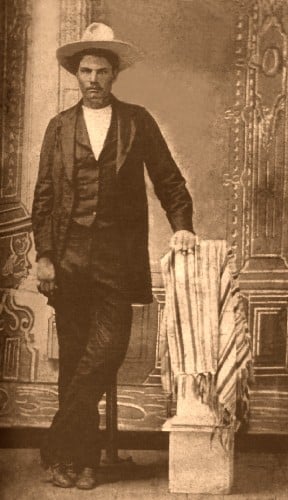
I Was Thinking About…John Wesley Hardin
By Andy Lee
The Old West conjures up images of swaggering outlaws, quick-draw shootouts, and frontier justice. And few gunslingers represent this lawless era better than John Wesley Hardin, perhaps the deadliest gunfighter in Texas. During his short but violent life he killed over 40 men, starting when he was just 15 years old. As I reflect on Hardin’s bloody trail, I’m struck by how his life illustrates the fine line between outlaw and legend in the American frontier.
Born in 1853 in Texas, Hardin grew up surrounded by violence and chaos. The aftermath of the Civil War left Texas bitterly divided. Union occupation fueled resentment and distrust. Freed slaves became targets of white rage. Outlaws took advantage of the turmoil, knowing lax law enforcement meant they could act with impunity.
Ironically, John Wesley Hardin was named for the founder of the Methodist movement, John Wesley. His family was devoutly religious, and Hardin was taught biblical scriptures from a young age. He even became a fervent churchgoer during his later years in prison.
Yet despite his pious namesake and strict religious raising, Hardin devoted his early life to lawlessness and murder. His parents, James “Gip” Hardin and Mary Elizabeth Dixson, did not approve of their son’s violent ways. But the chaos and lack of authority in postwar Texas enabled Hardin to pursue his own path. The dangerous frontier environment soon drowned out his early biblical lessons, replacing them with notoriety and rebellion instead of faith and righteousness.
In this environment, Hardin quickly became a killer. His first victim was an ex-slave who allegedly attacked him. At 17, he claimed another six lives following a shootout with Texas Rangers. Hardin often killed men simply for snoring too loudly or cheering for the wrong side. Each time, he managed to evade authorities by hiding out or claiming self-defense.
Hardin’s sprees of senseless murders left communities of former slaves and Union loyalists terrified. They knew any minor offence could leave them dead at the teenage gunslinger’s hands with no recourse or justice. Hardin’s violence was symptomatic of the disregard for minorities and dissenters that plagued the postwar Texas frontier.
To escape the law, Hardin moved out West into the cowboy country. There his lethal reputation grew. Hardin would frequently drink and gamble with the hard-living cattle drovers, always proving the fastest gun in any confrontation. By his mid-20s, he had been arrested, broken out of jail, recaptured, and ended up killing his own brother-in-law in a dispute after a card game.
America remains fascinated by rebels and rogues who represent the fierce individualism of the frontier. Figures like Jesse James and Billy the Kid embodied the outlaw spirit, stealing from the rich and evading corrupt officials. But this tendency obscures the true legacy of lawlessness that empowered men like Hardin to kill with impunity. With lawmen scarce, gunslingers dispensed their own warped form of “justice,” spreading terror in the process.
Contrast Hardin with the marshals and sheriffs trying to establish order amidst the chaos. Heroes like Wild Bill Hickok patrolled violent cattle towns, faced down drunken gunslingers, and died in the line of duty. Some even apprehended Hardin at times. Yet we recall Hickok more as a frontier celebrity than peacekeeper. Gunfighters like Hardin stole the limelight from lawful lawmen.
After yet another dramatic prison escape, Hardin tried going straight in Florida. But trouble found him. Hearing about a man named Warren out West claiming to be him, Hardin confronted the imposter on a train and shot him dead without hesitation. Now a husband and father, Hardin realized his outlaw days had to end.
Hardin surrendered in 1877 and served 17 years in prison before being pardoned. While incarcerated, he studied religion and law and wrote an exaggerated autobiography. Released in 1894, the once notorious gunfighter lived quietly as an attorney in El Paso, keeping his head down till his death at age 42 from being shot in the back by a lawman.
In pop culture, Hardin remains a mythologized antihero, sanitized on screen by directors seeing only his celebrity. But this overlooks the suffering of those terrorized by his violence. Hardin murdered without remorse to build his reputation, yet is romanticized as a misunderstood rebel defending justice.
As we weave the tale of the Old West, let us critically examine the figures glorified in art and literature. Hardin’s chilling saga can teach us much about conscience and consequence if we have the courage to see it clearly, instead of buying into dangerous myths that obscure the true cost of lawlessness. The frontier was not as morally black and white as portrayed in movies. The lines between hero and villain were often blurred, with innocents too often suffering the consequences.
For today, I was just thinking about John Wesley Hardin, notorious killer and mythologized antihero. His bloody life illustrates America’s complex relationship with the flawed icons of our frontier past.
Stay curious, keep exploring. 😊
Dive into the depths of history – subscribe for tales of forgotten lives and times delivered to your inbox.
 I was thinking about...