
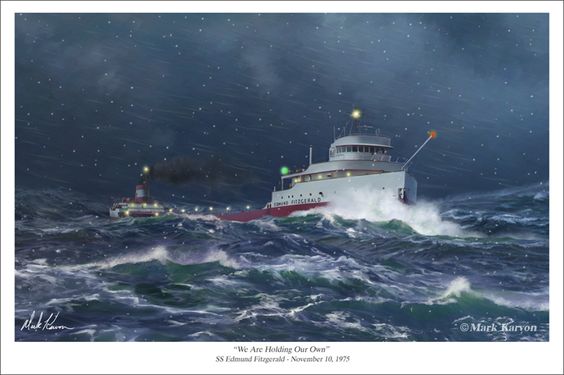
I was thinking about…The wreck of the Edmund Fitzgerald
By Andy Lee
I was thinking about the wreck of the Edmund Fitzgerald, which sank in a storm on Lake Superior in 1975, taking all 29 crew members aboard to their deaths. Even now, nearly 50 years later, the cause of the infamous ship’s sudden sinking remains shrouded in mystery.
The Fateful Voyage
On November 9, 1975 the Fitzgerald set sail from Superior, Wisconsin en route to Detroit with a load of iron ore pellets. As it crossed Lake Superior, a massive winter storm was brewing with near hurricane-force winds and waves up to 35 feet high. The 729-foot Fitzgerald was captained by Ernest McSorley, a seasoned sailor on the Great Lakes who had helmed the ship since 1972.
As the storm rapidly intensified, the Fitzgerald made radio contact with another nearby freighter, the SS Arthur M. Anderson. The Anderson provided shelter from the storm, allowing the Fitzgerald to sail in its wake. But by 7 p.m. on November 10, the ferocious winds and waves battered the ship. Captain McSorley reported radar trouble and later communicated that the ship was listing and taking on water.
Mysterious Sinking
Not long after, around 7:10 p.m., the Anderson lost all radio contact with the Fitzgerald. Tragically, the ship had broken apart and sunk to the bottom of Lake Superior about 17 miles from Whitefish Bay in the Canadian waters of the lake. All 29 crew members perished in the wreck.
When the Fitzgerald failed to reach its destination in Detroit, a massive U.S. and Canadian Coast Guard search was launched. After two days, searchers located the two pieces of the broken ship on the lake floor more than 500 feet below the surface. Though they found some floating debris and several crewmen’s bodies, the majority remain missing along with the wreck itself.
Theories on the Tragedy
Several theories have tried to explain what caused the Fitzgerald to sink so suddenly that fateful night. Some speculate that structural failures led to uncontrolled flooding when the cargo hold flooded. Others suggest rogue waves swamped the deck or shoulder-high waves smashed the hatches closed. Faulty hatch covers may have allowed water to deluge the cargo hold. Or worsening weather could have caused improperly secured cargo to shift and capsize the vessel.
The wreck itself may hold clues, but exploring the debris field half a mile under the lake’s surface poses immense technical challenges. In 1995, remotely operated vehicles did retrieve the ship’s bell and inspect key areas of the wreckage. While the cause is still disputed, the bell was inscribed with the names of the lost sailors to memorialize them.
Legacy and Lessons
The Edmund Fitzgerald disaster stunned the Great Lakes shipping industry and maritime community. It remains the largest ship to sink in Lake Superior. The tragic unsolved mystery has gained notoriety in part due to Gordon Lightfoot’s haunting 1976 ballad “The Wreck of the Edmund Fitzgerald.” The song memorialized the lost seamen and eerie questions surrounding the ship’s demise that still remain unanswered four decades later.
For me, the saga carries lessons about the power of nature and human limits in the face of its fury. The Edmund Fitzgerald was a modern freighter captained by an experienced crew carrying routine cargo in familiar waters. Yet a convergence of small oversights – a faulty hatch, unstable loading, missed weather cues – can rapidly spiral out of control on the seas.
The causes of disasters are seldom simple. But even small mistakes can combine with chance to produce catastrophe. There is ultimately only so much we can do to bend chaotic nature to our will. The wreck of the Edmund Fitzgerald reminds us to respect the forces that exceed our grasp. As Gordon Lightfoot sang, “The lake, it is said, never gives up her dead.” Some mysteries are beyond our capacity to solve.
The story still fascinates as evidence that our knowledge has limits. The exact circumstances that shattered the mighty Fitzgerald may never come fully to light. On stormy November nights, I can’t help staring across Lake Superior and wondering what truly happened on its frigid waters. The Edmund Fitzgerald endures as a sobering reminder of forces greater than us.
Stay curious, keep exploring. 😊
 I was thinking about...