
I was thinking about…The Salem Witch Trials
By Andy Lee
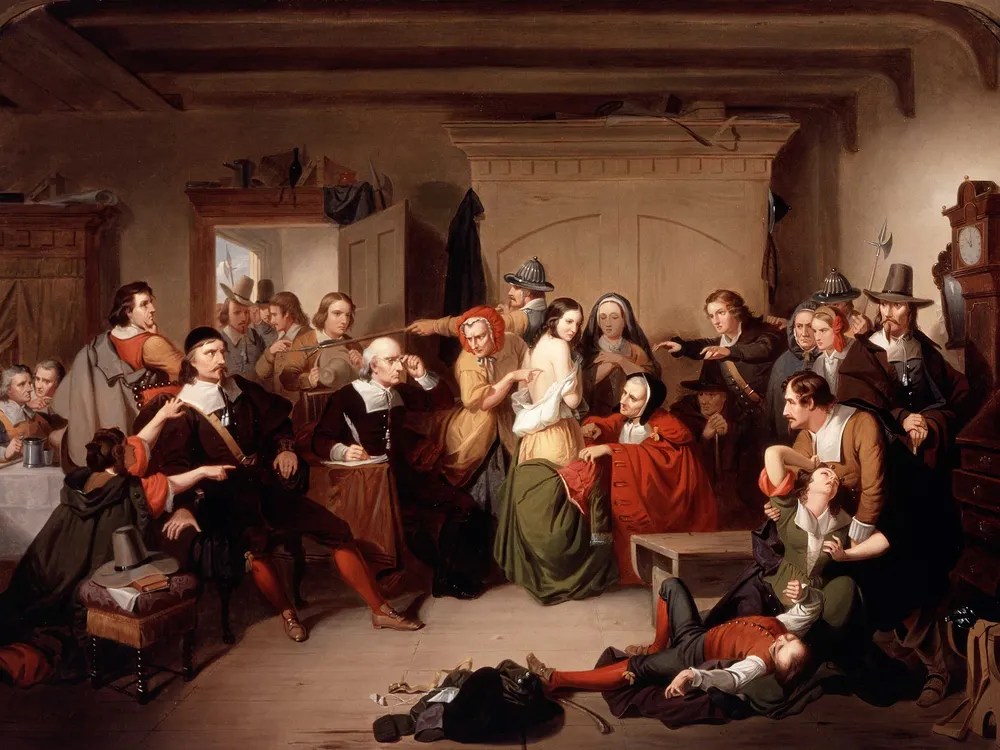
In colonial Massachusetts, a series of bizarre accusations led to a period of paranoia, false convictions, and the execution of innocent people accused of witchcraft. This disturbing chapter in early American history has become synonymous with mass hysteria and scapegoating. I was thinking about the Salem witch trials of 1692 and what factors drove ordinary people to irrational fear and suspicion.
Salem Village, present-day Danvers, was known for its disputes over property, grazing rights and church privileges. In January 1692, Reverend Samuel Parris’ daughter Betty and niece Abigail began experiencing mysterious fits and body contortions. Other local girls soon displayed similar symptoms, fueling rumors of supernatural forces.
With superstitions running rampant, three women were accused of witchcraft: Caribbean slave Tituba, homeless beggar Sarah Good, and Sarah Osborne, who rarely attended church. During her interrogation, young Abigail Williams accused Tituba of forcing her to drink blood and ride a broomstick. Under intense questioning, Tituba confessed to seeing the devil and also accused Good and Osborne. All three were jailed, setting off waves of accusations from other young girls in the community.
Hysteria snowballed as the accusers pointed fingers at anyone they disliked. Within a month, Martha Corey, Dorothy Good and Rebecca Nurse were arrested, astonishing locals by their reputation as upstanding church members. Even the village doctor’s wife, Ann Sears, was accused of witchcraft. Jail cells filled rapidly as children accused teachers, servants accused masters, and personal grudges turned deadly.
Trial judges included Reverend Parris, pushing him to fervently back the accusations to avoid admitting he allowed witchcraft under his roof. The frenzied witch hunt expanded beyond Salem to towns like Andover, where another minister’s maid confessed and began accusing others. Evidence was scant and convictions were largely based on “spectral evidence” – testimony that a defendant’s spirit or apparition appeared to or afflicted the accusers. This unreliable and uncorroborated evidence sealed the fates of many innocents.
While both men and women were accused, women were disproportionately targeted. Seventy-eight percent of accused witches were female. Deep-rooted sexism led many to suspect female neighborhoods of consorting with the devil. Older single women and those with unconventional habits were especially vulnerable to accusations.
By September 1692, nineteen accused witches had been executed by hanging. Another man, Giles Corey, was brutally pressed to death with heavy stones for refusing to enter a plea, a process that took three days. Dozens more awaited trial, with new accusations mounting daily. But doubts were growing as prominent men began speaking out against the hysteria. Reverend Cotton Mather urged caution in relying on spectral evidence, arguing that apparitions could represent deception by the devil.
In October, Governor Phips dissolved the Court of Oyer and Terminer that had presided over the witch trials. The following year, his wife was accused of witchcraft. Phips quickly halted witchcraft proceedings, releasing many inmates. Years later, jurors and judges publicly confessed their errors and regret for the Salem witch hysteria. In 1711, the Massachusetts colonial legislature annulled the convictions and offered restitution to families of the victims.
The Salem community suffered decades of tension and division in the aftermath. Survivors faced trauma, grief, and continuing stigma even after being cleared of wrongdoing. It took over 250 years for Massachusetts to formally apologize for the trials. In 1992, an annual Salem Witch Trials Memorial Observance was established to honor victims.
While witchcraft fears died down in New England, many lessons remain relevant today. The Crucible by Arthur Miller and more recent works like Stacy Schiff’s The Witches provide rich insights into this dark period. Prejudices against women, poor, and marginalized people fueled the accusations. False convictions occurred from insufficient evidence and absence of due process. Community disagreement descended into vindictive finger-pointing. And the media, in the form of sensationalist sermons, exacerbated the panic. The Salem witch trials illustrate how fear and blame can corrupt human reason when ethics and compassion are abandoned.
While twenty innocent people lost their lives, the legacy of 1692 endures to promote justice. In Salem, memorials honor those wrongfully executed and clear their names. The tragic events remind us to value fact over conjecture, uphold fair trials, question overly simple explanations, and preserve human dignity when faced with the inexplicable. Rather than meet the unknown with fear, we can proceed with care, wisdom and humanity. If fear took root in Salem, the lessons of that time can perhaps help prevent hysteria’s spread today.
Stay curious, keep exploring. 😊
Can’t get enough little-known historical tales? Satisfy your interest by subscribing to receive fresh perspectives on the past in your inbox. Let’s continue exploring overlooked moments together – sign up today.
 I was thinking about...