
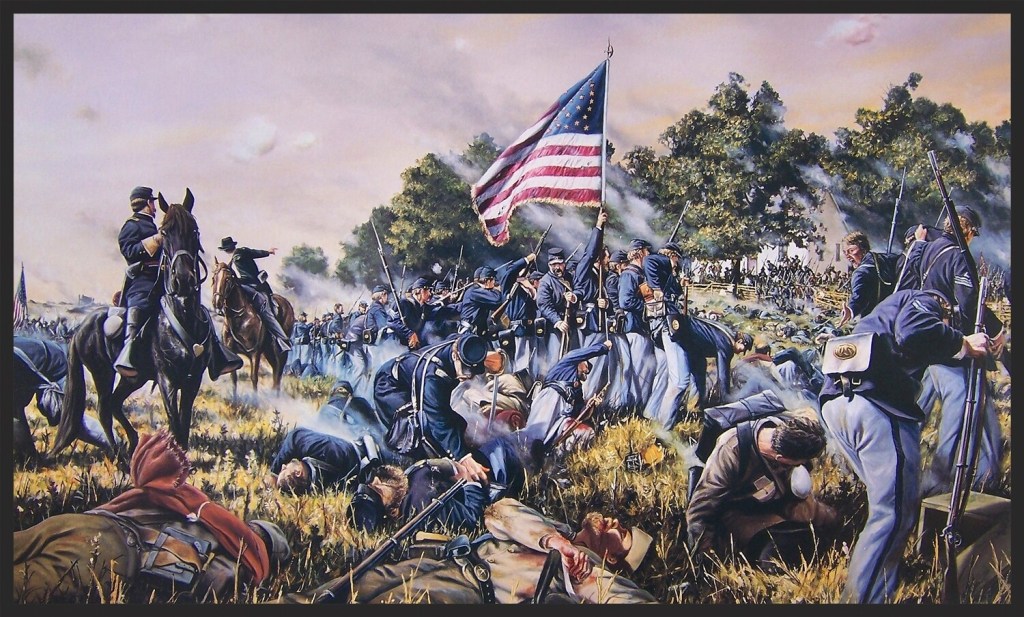
I Was Thinking About…The Battle of Antietam
By Andy Lee
Few events encapsulate the horrific carnage and pivotal turning points of the Civil War like the Battle of Antietam. As the bloodiest single-day battle in American history with over 22,000 casualties, Antietam saw slaughter on an unimaginable scale. But it also marked a crucial moment when President Lincoln reshaped the war’s aims by issuing the Emancipation Proclamation, ultimately advancing the cause of freedom.
Confederate General Robert E. Lee’s first major invasion of the North was halted near Antietam Creek in rural Maryland by Union forces under General George McClellan. Outnumbered, Lee had aggressively marched his men toward Philadelphia and Harrisburg, hoping a decisive win on Northern soil could secure Southern independence. But McClellan intercepted Lee’s daring incursion, setting the stage for the pivotal battle.
“The sun seemed almost to go backwards, and it appeared as if night was to be ushered in,” wrote one stunned Southern officer as fighting engulfed the area on September 17, 1862. Attacks swept back and forth across the corn and sunflower fields around Antietam Creek, with heavy casualties mounting. “I saw swaths of men mowed down as a scythe cuts through wheat,” recalled a Union officer of the carnage wrought by artillery ripping through the rows.
Chaos reigned around the tiny town of Sharpsburg, as the armies grappled over a humble church and stone bridge across the creek. Both structures were reduced to rubble amid relentless volleys of rifle fire. The bridge changed hands multiple times, with control bought at a fearful price. “We entered the fight with 1,100 men and left with 300,” recorded one Alabama unit decimated in the vicious combat over this focal point.
When the smoke finally cleared on September 18th, the Battle of Antietam had unleashed mind-numbing devastation upon both armies. Around 4,700 soldiers were killed, while over 17,000 were wounded or missing. The combined casualty count neared an unprecedented 23,000 in the one-day clash. Blood soaked field hospitals as piles of severed limbs mounted. Clara Barton, who aided the wounded, wrote, “No words can tell, no tongue can describe…such a picture of hell.”
Though Lee withdrew his decimated force back to Virginia, Antietam marked a strategic victory for the Union. McClellan’s success finally halted the momentum of Lee’s victories and controversial incursion that had electrified the South. Antietam showed the Confederacy was not invincible despite its aura of momentum.
Just as importantly, Antietam dissuaded Britain and France from recognizing or intervening to support the rebellion. This denial of foreign aid was a major blow to the Confederacy’s prospects. Most crucially, just five days after Antietam, President Lincoln issued the Emancipation Proclamation as a war measure. This act transformed the conflict into an explicit fight against slavery itself, providing undeniable moral purpose to Union sacrifices.
In the Proclamation’s wake, both sides realized victory would require far more bloodshed than anticipated. But the Union could now fight strengthened by the righteousness of their cause. The losses were not in vain, but a necessary sacrifice on the road to liberty. Though the fields remain blood-hallowed ground, the greatest monument to Antietam is the advance of freedom rising from our nation’s most horrific day of battle.
Stay curious, keep exploring. 😊
 I was thinking about...