
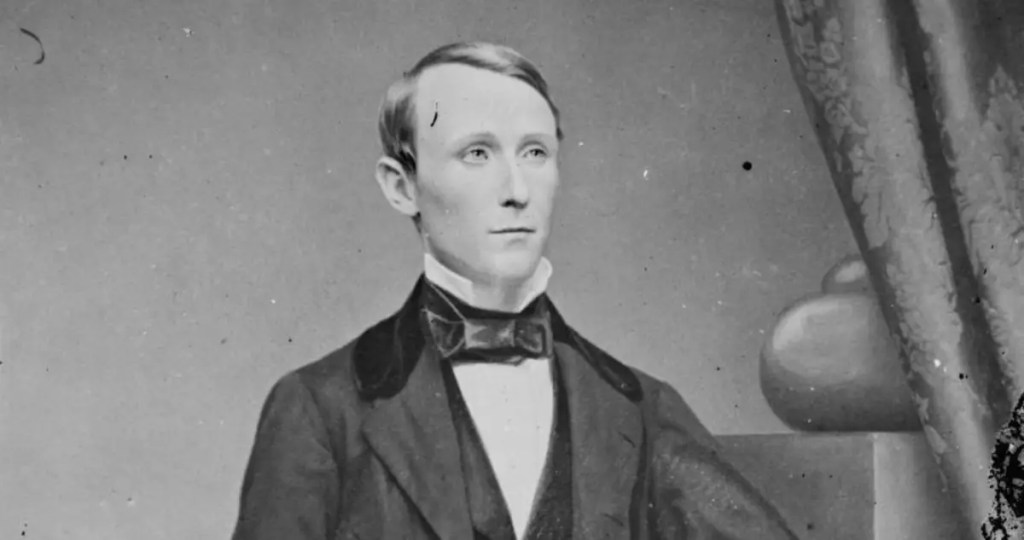
I was thinking about…William Walker
By Andy Lee
In the volatile years leading up to the U.S. Civil War, American adventurer William Walker led a privately funded expedition to Nicaragua in 1855, overthrew its government, and installed himself as president for nearly one year before being ousted in 1857. Walker’s brazen mission must be examined within the context of the era’s heated political disputes around slavery and manifest destiny in Latin America.
Born in 1824 to an influential family in Tennessee, William Walker was a staunch proponent of the prevailing Southern views on slavery and its potential expansion westward into new territories. At that time, the young United States was fracturing along sharp sectional divisions, with escalating clashes between pro-slavery Southerners seeking to widen slavery’s reach and anti-slavery Northerners opposed to its extension into the west.
It was against this turbulent political backdrop that Walker first conceived his scheme to conquer regions of Latin America in order to establish new slave states that would increase the South’s political representation and influence in Washington. To accomplish his vision, Walker embarked on a series of privately funded expeditions aimed at asserting control over areas south of the United States border. After mounting a failed first attempt to colonize Mexico’s Baja Peninsula in 1853, Walker proceeded to redirect his filibustering efforts toward Nicaragua, a Central American republic then embroiled in a bitter civil war between pro-slavery Conservative Party forces and pro-business Liberal Party factions.
Arriving in Nicaragua in mid-1855, Walker shrewdly aligned with the Liberal coalition against the Conservatives by claiming they shared a common enemy. However, once Walker’s small mercenary army succeeded in defeating the Conservative forces and obtained control over the Nicaraguan military, he quickly turned on his Liberal allies. Accusing them of disloyalty, Walker boldly took unilateral control of the government himself.
Upon seizing power in 1856, President Walker instituted a series of controversial policies aimed at benefiting his own ambitions rather than the Nicaraguan people. He declared English the nation’s sole official language, re-instituted slavery, confiscated assets from Nicaraguan elites, and implemented harsh laws to suppress any resistance from the local populace. According to accounts from activists like writer Josefa Palacio, Walker’s egregious power grab provoked intense backlash and “a storm of atrocities” against Nicaraguans who dared stand up to his oppressive regime. By 1857, Walker had thoroughly alienated citizens across all Nicaraguan political factions, along with leaders of neighboring Central American countries. This widespread opposition ultimately led to a coordinated regional assault that succeeded in driving Walker’s mercenary forces out of Nicaragua, thus ending his brief but highly disruptive one-year rule.
Despite being firmly deported back to the United States in defeat, Walker stubbornly persisted in mounting three additional unauthorized military expeditions between 1857-1860 aimed at seizing control of various Latin American territories. However, his repeated forays were consistently met with failure. Walker’s long-running attempts to invade Latin America finally ended in 1860 when he was captured and executed in Honduras. Historian Michele Gillespie noted that William Walker’s repeated imperialist adventures left enduring scars by fueling intensive anti-American sentiments across Latin America that lingered for many decades after his death.
While Walker earned praise from some pro-slavery advocates in the southern U.S. for his zeal, contemporary scholars overwhelmingly view his rogue escapades as scandalous emblems of 19th century American imperialist expansionism at its absolute most unconstrained. Ultimately, Walker’s legacy still endures as a sobering cautionary tale about the immense human dangers posed whenever ideological zealotry and misguided dreams of national manifest destiny are allowed to totally supersede universal human rights, international law, and common human decency.
Stay curious, keep exploring. 😊
 I was thinking about...