
I Was Thinking About…The Lost State of Franklin
By Andy Lee
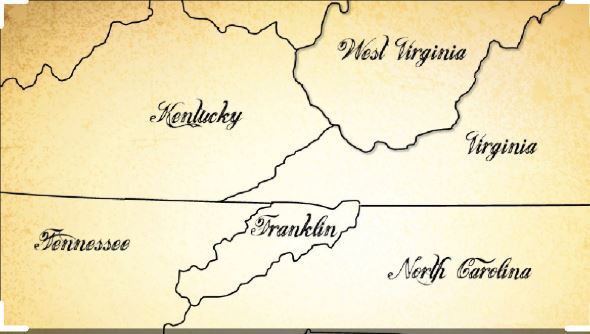
Few people today are aware that before it joined the Union, parts of what is now Tennessee tried to establish an independent republic known as the State of Franklin. Lasting only four tumultuous years from 1784 to 1788, this fleeting attempt at statehood has largely faded from memory. As I look back on Franklin’s unconventional history and demise, several ironic aspects of this rebellious experiment stand out.
Franklin emerged from frustrations like those of Andrew Jackson, whose political ambitions were stifled by the dominance of eastern elites in North Carolina politics. Western settlers also bitterly resented unfair land policies and lack of protection from Indian attacks. These grievances intersected with frontiersmen’s fierce spirit of independence.
In late 1784, settlers convened the Watauga Convention to declare autonomy from North Carolina. Delegates named the new state Franklin after Benjamin Franklin, hoping to gain the support of this prominent advocate for frontier interests. They zealously pursued recognition, even establishing the rudiments of self-government like a constitution, legislature, courts and militia.
But grave challenges doomed Franklin from the start. The territory lacked funds and struggled to collect taxes from its sparse and scattered population. North Carolina refused to cede control of the region, considering Franklin an illegal usurpation. Congress also rejected Franklin’s appeals for admission to the Union. These dual rejections crippled legitimacy and hopes for prosperity.
Franklin’s inability to defend its porous borders led to constant Cherokee raids that drove away settlers and prevented economic growth. Without tax revenue or outside aid, the region descended into anarchy. After just four years, Franklin effectively collapsed, leaving influential leaders like John Sevier chastened by the difficulties and realities of state-building.
Ironically, many former Franklin officials went on to prominent careers in the future state of Tennessee, which formally joined the Union in 1796. But they carried lessons about pragmatism and governance from Franklin’s failed experiment. Even John Sevier served six terms as Governor of Tennessee.
Though short-lived, Franklin demonstrated the West’s spirit of defiant self-determination that later influenced Tennessee politics. Leading figures like Andrew Jackson grew from the failed state effort to become dominant regional power players. The legacy of Franklin’s fiercely independent settlers persisted even after its dissolution.
Franklin’s demise highlighted the fragile beginnings of federalism, as the young American nation struggled to balance unity with local ambitions. But the settlers’ yearning for control foreshadowed the eventual statehood of Tennessee. Their experiment should be remembered for its audacity, if not success.
Some historians have speculated how the region might have developed had Franklin managed to join the Union. An independent Franklin would have complicated the concurrent negotiations between Spain and America over control of the Mississippi River. But recognizing Franklin’s statehood could have brought the fiercely independent Appalachian settlements into the American political system decades earlier.
Franklin’s founders sought to escape dependence on the great slave plantations and Indian wars that dominated the old South. Perhaps an independent Franklin would have attracted more small farmers and artisans, shaping an upland South with a different culture and economy. But these speculations remain tantalizing conjecture.
Instead, Franklin serves as a fascinating cautionary tale in constitution-building and the difficulties of erecting new states from scratch. The Lost State of Franklin was a bold but premature experiment born at a time when America’s political structures remained fragile and contested. The lessons of its failure contributed to more lasting nation-building achievements as the country matured. We can appreciate its settler’s restless pride and imagination, even if their would-be state dissolved as swiftly as it emerged.
Stay curious, keep exploring!
 I was thinking about...