
I Was Thinking About…The Mountain Meadows Massacre
By Andy Lee
Few episodes in 19th century American history are as chilling as the Mountain Meadows massacre of 1857. This chilling act of violence saw a band of Mormon militiamen and Native American raiders slaughter around 120 westbound emigrants at a remote mountain pass in southern Utah. Though it occurred over 150 years ago, the massacre still haunts the history of the Latter-day Saints and the settling of the American West. As I reflect on this dark event, several aspects stand out that explain its origins and legacy.
In 1857, roughly 500 members of the Baker and Fancher emigrant wagon trains were traveling west to California from Arkansas. These emigrant trains were primarily families of modest means hoping to start new lives. However, wild rumors quickly spread among the Mormons in Utah that the Arkansas emigrants were violent opponents carrying weapons and poisons to harm the Latter-day Saint community.
Tensions between Mormons and non-Mormons had been simmering for years, ever since the Latter-day Saints settled around the Great Salt Lake starting in 1847. Their community practiced plural marriage, which anti-Mormons despised as immoral polygamy. The Latter-day Saints also occupied a strategically valuable area that the U.S. federal government wanted to control. Resentments simmered on both sides.
The Mormons who attacked the wagon trains were primarily local militiamen of the Utah Territorial Militia organized by prominent LDS leader Isaac Haight. However, historical evidence indicates that their leaders, including Haight, acted defiantly against the orders of more senior Mormon authorities like Brigham Young. The militiamen were counseled by Paiute Native Americans who saw the emigrants as infringing on their lands.
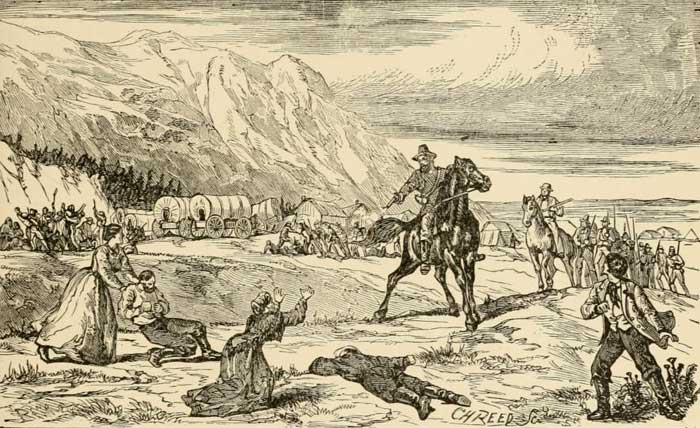
On September 7, 1857, the Mormons and Paiutes ambushed the besieged emigrants at Mountain Meadows in southwestern Utah, about 35 miles from the emigrant’s last resupply point in Cedar City. The attackers initially approached under a white flag, convincing the Arkansans to lower their defenses. But once the emigrants were lured out into the open, the militiamen and Paiutes unleashed a brutal assault.
They massacred the men first, then gathered the women and children together before slaughtering them. Only 17 young children survived, spared as deemed too young to reliably describe the attack. The victims’ bodies were hastily buried in shallow graves, left exposed to scavenging animals. A few Native American accounts describe vengeful militiamen desecrating the corpses of the women.
When news of the atrocity trickled out, the American public was horrified. However, the motivations behind the crime and its perpetrators remained murky for years due to smokescreens by Mormon leaders.
Only in the 1870s did the U.S. military conduct an official investigation and trial of the massacre’s primary orchestrators, like Haight and Paiute leader Chief Jackson. But the full truth behind the Mormons’ and Paiutes’ actions only emerged decades later through extensive historical research and archaeological studies at the massacre site.
The investigations revealed how groundless paranoia and religious prejudice combined with Indian hostilities to spawn an act of mindless carnage. While early Mormon accounts suggested the Arkansans played some provocative role, the emigrants were in fact simple settlers seeking a better life. The tragedy resulted from distrust spiraling out of control in the desert wilderness.
Today, the massacre site is a National Historic Landmark. Controversy around assigning blame has subsided. The LDS Church officially expressed regret for the atrocity only in 2007. This occurred 150 years after the massacre. The Paiutes have formally apologized as well. While the massacre strained Mormon relations with the U.S. government for decades, time has allowed for acknowledgement of its complex circumstances by all involved.
For me, reflecting on Mountain Meadows provides lessons in how quickly suspicion and dehumanization of outsiders can corrupt people’s moral compass and provoke shocking cruelty, even among the devoutly religious. It reveals how tenuous order was in the mid-19th century West, where settlers’ survival felt threatened by harsh conditions and proximity to Native lands.
Most of all, the massacre underscores humanity’s capability for both compassion and senseless evil. Those impulses collide rarely but unforgettably in events like Mountain Meadows, underscoring the need for conscience and moral courage. On an isolated mountain plain, innocent families seeking only new lives were engulfed in horrors they could scarcely comprehend. The massacre’s tragic story will forever haunt both Utah’s magnificent landscape and the memories of those bound by faith or blood to its perpetrators and victims. We must neither forget nor wholly condemn those involved but instead reflect solemnly on this stain of atrocity amidst an epic period of exploration and settlement.
Stay curious, keep exploring!
 I was thinking about...