
By Andy Lee
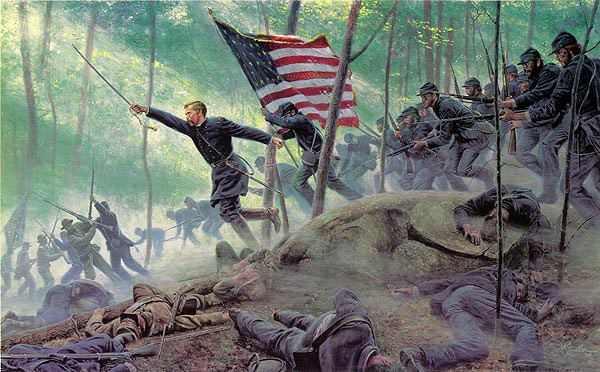
I was thinking about the Battle of Gettysburg and how it really was the major turning point of the entire Civil War.
Up until that fateful battle in July 1863, the Confederate forces had momentum on their side. They had won several key victories against the Union, including the Second Battle of Bull Run and Fredericksburg, and General Lee’s army seemed nearly unstoppable. The Confederacy was even pushing up into Union territory, taking the war to the North.
But when Lee invaded Pennsylvania in the summer of 1863, the Union army finally decided to take a stand. Under the new leadership of General George Meade, the Union forces concentrated around the small town of Gettysburg. When Confederate troops marched into Gettysburg on July 1st, they stumbled upon Union cavalry, and a skirmish ensued. Both sides quickly called for reinforcements, and heavy fighting broke out.
What happened over the next three days would change the course of the war. The Battle of Gettysburg saw the convergence of the two main armies of the Eastern Theater on a battlefield covering dozens of square miles of farms, ridges, and meadows around Gettysburg. An estimated 165,000 men clashed in what remains the largest battle ever fought in North America.
The second day of fighting centered on Union defensive positions on Cemetery Ridge and Culp’s Hill. Confederate General James Longstreet later wrote, “Never was I so depressed as upon that day.” In a series of massive frontal assaults, Lee sent his troops against the Union flanks in an attempt to break them. However, the Union lines largely held despite suffering over 9,000 casualties that day. Fighting also occurred in areas like the Wheatfield, Devil’s Den, and Peach Orchard as Confederate forces tried to gain ground.
On the third and final day, Lee decided to stake everything on a dramatic, massive frontal assault on the Union center on Cemetery Ridge. Preceded by a massive artillery bombardment, 12,500 Confederate soldiers advanced across open ground for over a mile towards entrenched Union positions in an assault that became known as Pickett’s Charge. One Confederate soldier recalled, “We could see the Federals in front of us, and their guns, which appeared to number a hundred or more, were trained directly upon us.” Union artillery and rifle fire decimated the Rebel assault, cutting down thousands of men. Those who did reach Union lines were pinned down and captured. Pickett’s Charge ended in disastrous failure, marking the final fruitless assault of the battle.
When the smoke cleared on July 4th, Gettysburg was over. The Union had held firm and repelled Lee’s invasion of the North. The Confederates suffered between 4,000-5,000 dead and over 20,000 wounded or missing. The Union also paid a heavy price with over 3,000 dead and 14,000 wounded. The scale of bloodshed was staggering, even for a war that saw many horrific battles.
But Gettysburg was a clear tactical victory for the Union. Lee’s Army of Northern Virginia lost over a third of its strength and was forced to retreat back to Virginia. They left behind thousands of dead and wounded as well as numerous artillery pieces and wagons. General Meade and the Army of the Potomac had succeeded in defending Union territory and stopping Lee’s rampage through the North.
The battle was a crushing blow for Confederate morale and hopes of victory. They had gambled on a Pennsylvania invasion to try to gain foreign recognition and strengthen their hand at the bargaining table. Gettysburg put an end to those ambitions. The Confederacy would remain on the strategic defensive for the rest of the war.
Gettysburg marked the high tide of the Confederacy. After this battle, they would not come close to threatening Union territory again. The Union boosted by the victory was able to seize the momentum. With the war now shifting in their favor, Union forces pressed their advantage, tightening their grip around the South. Over the next two years, General Grant would relentlessly hound Lee in Virginia while General Sherman carved a swath through Georgia and the Carolinas. Gettysburg made Union victory seem attainable.
The battle also had huge political implications. The twin Union victories at Gettysburg and Vicksburg, where Grant had just captured an entire Confederate army on July 4th, bolstered Northern morale. Peace Democrats who were willing to negotiate an end to the war lost influence. Lincoln was convinced he could insist on reunion and the abolition of slavery now that the North’s military fortunes were ascending. Gettysburg reenergized the Union war effort.
In many ways, Gettysburg represented both the culmination and turning point of the Civil War. It stopped Lee’s streak of victories and marked the high tide of the Confederacy’s bid for independence. The Union victory set the stage for ultimate Northern triumph and the reunification of the nation under the banner of freedom. Though nearly two more bloody years of war followed, Gettysburg was the beginning of the end for the Southern cause. This immense battle among the Pennsylvania farmlands truly earned its renown as the Civil War’s most decisive battle. Whenever I think about key turning points in history, the three day clash at Gettysburg stands out as an enduring symbol of how the course of nations can pivot on a single battle.
Stay curious, keep exploring!
 I was thinking about...