
By Andy Lee
I Was Thinking About Why I Think About the Roman Empire
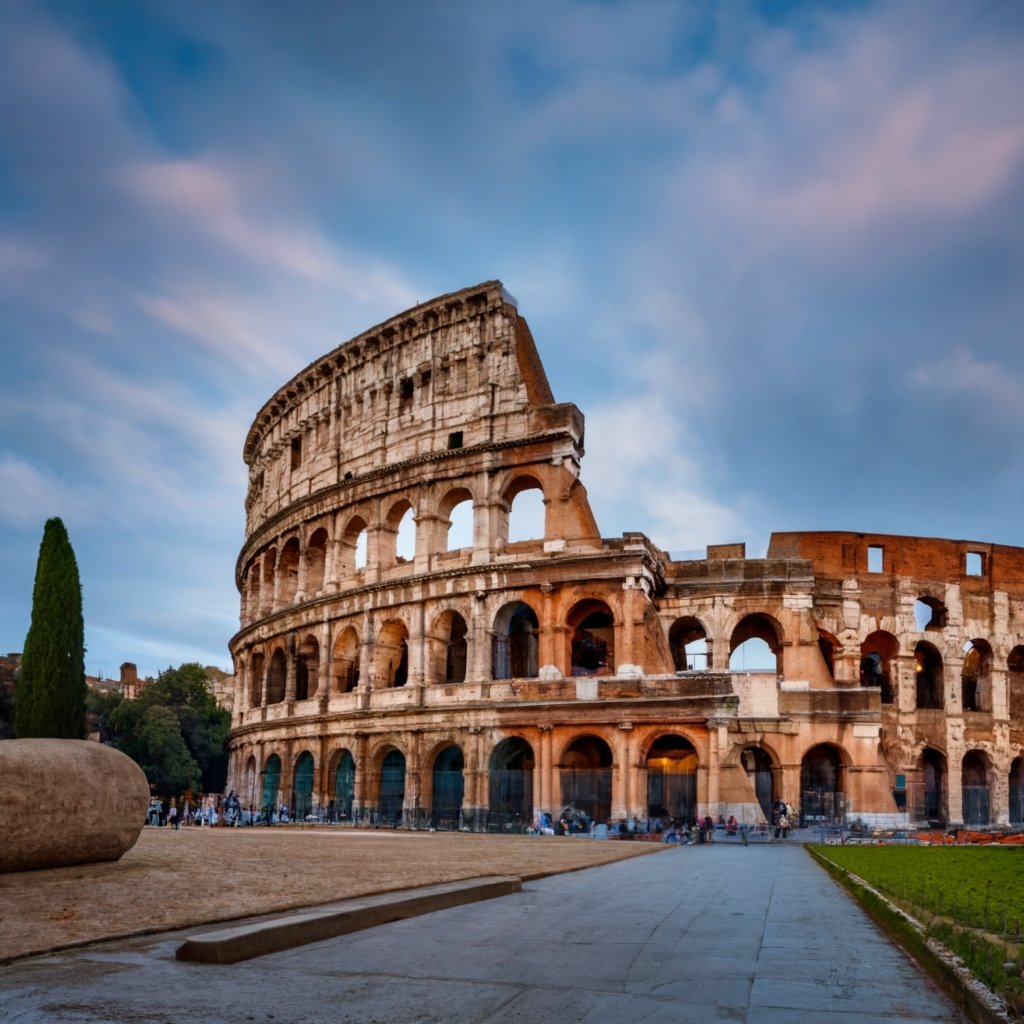
A friend recently asked me how often I think about the Roman Empire. She was shocked when I told her that it comes to mind practically every day. After seeing her reaction, she showed me some TikTok videos of women posing the same question to their partners, only to express disbelief at the men’s responses that they frequently think about ancient Rome. Like the women in those videos, my friend could hardly fathom my daily pondering of the Roman Empire from over 2,000 years ago. She was astonished that thoughts of Caesar, the Colosseum, Roman aqueducts, and the Pantheon would cross my mind almost daily rather than rarely or never. While the Romans may have vanished centuries ago, their civilization still enters my mind on a nearly daily basis. There are a few key reasons why the Roman Empire remains firmly lodged in my thoughts…
Unmatched Historical Impact
The Romans were master engineers, pioneering numerous technologies and infrastructure that remained unsurpassed for over a thousand years. Roman concrete enabled the construction of architectural marvels that still stand today, like the Pantheon with its awe-inspiring dome spanning 142 feet wide. Aqueducts supplied fresh water through an elaborate network stretching over 250 miles to provide water to Rome’s over 1 million inhabitants – a feat unmatched until the 19th century. The Romans built over 50,000 miles of roads to facilitate travel and trade. Meticulous Roman surveyors carefully planned routes, allowing the Romans to rule and control such a vast empire.
The Romans even developed flushing toilets, public baths, and underground sewage systems well ahead of their time. In some ways, ancient Rome boasted a higher standard of living than 18th century European cities in terms of sanitation and fresh water supply.
Latin became the common language that united the empire. Over time it evolved into the Romance languages of Italian, French, Spanish, Portuguese, and Romanian that are still widely spoken today.
Beyond evolving into new languages, Latin itself remains influential through its use in science, law, and academia. Latin terminology is embedded in fields like medicine, with terms like terminus, lumbar, and trachea used to describe human anatomy. Legal phrases like habeas corpus, prima facie, and res judicata originate from Latin. Universities often use Latin mottos and Latin terminology is found in scientific names for plants and animals. Though no longer widely spoken, Latin persists through this specialized vocabulary.
Beyond infrastructure, Rome pioneered innovations in law, philosophy, government, mathematics, and literature that provided the foundation of Western civilization. Rome cultivated philosophers like Seneca and Marcus Aurelius who influenced Enlightenment thinkers centuries later. Roman law established a legal code and system of jurisprudence adopted throughout Europe. The Julian calendar with 12 months and 365 days remained the standard for over 1,600 years. Great works of literature like Virgil’s Aeneid and Ovid’s Metamorphoses shaped Western literature and poetry.
When the empire eventually collapsed, these advancements diffused beyond Rome’s borders to indelibly shape the world for millennia. The Romans created an enduring legacy emulated by civilizations for centuries to come.
Sophisticated System of Government
The Roman Republic’s system of checks and balances distributed power between the aristocratic Senate, popular assemblies, and elected consuls. This balanced but precarious structure eventually tipped into civil war and then autocracy under emperors like Augustus. Yet the Empire maintained governance institutions like the Senate as well as law codes and bureaucracy. In contrast, the United States has remained a stable constitutional republic for over 200 years by learning from Rome’s model but empowering a democratically elected legislature, an independent judiciary, and separation of powers across federal and state governments. Studying Rome provides unique insights into how a civilization can blend democracy, republicanism, and imperial power while navigating the tensions between liberty and central authority. America’s founders carefully studied this legacy.
Rome’s Influence on Daily Life
Rome’s influence permeates our daily lives in profound yet subtle ways. The alphabet and calendar we use originated in Rome. Western urban design continues to be influenced by Roman city planning principles like gridded streets, central public squares, arenas, bathhouses, and aqueducts. The Romans pioneered the use of arches and domes which became staples of subsequent Western architecture. Roman infrastructure innovations like highways and bridges are ubiquitous parts of modern transportation systems. Notions of republicanism and democracy modeled on Rome underpin many modern governments. Concepts of civic duty and natural law were established by Roman philosophers and jurists. The Romans’ massive influence is visible in innumerable aspects of Western language, literature, engineering, architecture, government, technology, and culture. Echoes of this ancient civilization continue to shape the world today.
The Roman Empire may have fallen over 1,500 years ago, but its influence endures in countless ways. Roman innovations in engineering, language, law, government, philosophy and culture provided the backbone of Western civilization. While the mighty empire eventually crumbled due to corruption, inequality and civic disengagement, the ideals it championed remain embedded in modern democracies. Yet Rome’s fate also serves as a sobering reminder that no civilization, no matter how advanced or powerful, is immune to decline if its citizens neglect their role. This ancient civilization provides perspective on humanity’s potential for both progress and peril. For anyone seeking to understand the wellspring of Western society, the Roman Empire offers an endlessly fascinating lens into the past that still shapes our present. I know I will continue pondering this captivating history for years to come.
Stay curious, keep exploring!
 I was thinking about...