
I Was Thinking About…How Dorothea Lange’s Photography Captured the Human Impact of Historical Events
By Andy Lee
I recently became fascinated by photographer Dorothea Lange while learning about her incredible work documenting the human side of major historical events. As a photojournalist during the Depression, Lange created empathetic portraits conveying how societal upheavals affected everyday people. Her images stand out for capturing emotional truths during challenging times.
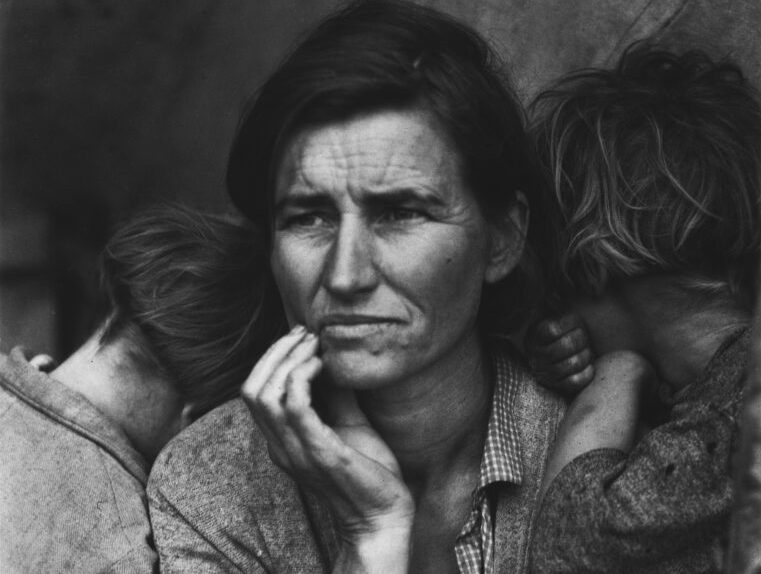
When the Great Depression left thousands poverty-stricken and displaced, Lange photographed their plight firsthand. Traveling through California, she made candid portraits of destitute migrant farm workers that stirred society’s conscience. In “Migrant Mother,” her most recognized image, a weary mother cradles her children, their worry etched on their faces. Lange had compassionately listened as the mother described struggling to feed her kids after the crops froze. Her empathy comes through in the emotional intimacy of the photo.
As Lange explained, “My own approach is based upon respect for the dignity and intrinsic importance of every human being.” She sought to give the downtrodden visibility and voice through her work. Her photos of breadlines, labor camps, and rural hardship put faces to the statistics, capturing the sacrifices of men, women and children just trying to survive the depths of the Depression.
One especially moving 1935 photo shows an anxious mother and father clasping hands as they send their children off to Scotts Run, West Virginia, where living conditions were even harsher than where they came from. But it offered some semblance of opportunity. Lange’s composition underlines the painful dilemma the parents faced, torn between keeping the family together and allowing the kids a chance at something better.
During World War II, the War Relocation Authority hired Lange to document Japanese American incarceration. Although censors suppressed much of her work, we have about 800 photos offering a window into the injustice. Images show makeshift barracks, a child’s Mickey Mouse doll left behind, and the resolute faces of those stripped of freedom.
One especially moving photo depicts a lone man in a porkpie hat waiting by a Miller’s Delivery truck for transportation to the internment camp at Manzanar. His calm dignity and peaceful acceptance while facing an unjust loss of rights speaks volumes. Lange’s photos put the harsh reality of Executive Order 9066 in human terms the public could understand.
Throughout her career, Lange’s camera focused on those she felt were under-represented in society and mainstream narratives – field laborers, prisoners, minorities, and working women. She sought to capture their oft-unnoticed strength and perseverance. As she put it, “The camera is a powerful instrument for social documentation, and it can and should be used for social betterment.”
Decades later, Lange’s compassionate images still affect viewers profoundly. She photographed universal human experiences like hope, sacrifice, and endurance that transcend the circumstances. Her compositions expertly evoke subtle details that kindle our empathy. Lange’s work reminds us that beneath surface differences, our shared humanity endures.
The iconic photos Dorothea Lange created have become woven into America’s collective memory. Whether depicting struggle or quotidian life, her body of work conveys our common bonds. She will be remembered for training her lens on overlooked people and illuminating their moving narratives.
Though gone, Lange and her empathetic photography still urge us to truly see the unseen, listen to the unheard, and understand our shared lot as part of the human family. Her work continues to profoundly move those who view it generations later.
As Lange reflected, “A camera is a tool for learning how to see without a camera.” Her images stemmed from patiently listening to her subjects’ stories first. Lange believed a good photographer must connect on a human level with the people and lives they document. This sense of compassion pervades her body of work.
While impossible to encapsulate an entire lifetime in one blog post, I hope this provides a window into the far-reaching impact of Dorothea Lange’s photography. She was an artist who also happened to be a masterful social documentarian. Lange once said, “Photography takes an instant out of time, altering life by holding it still.” Her inspiring work froze powerful instants for all time, images that still resonate in our collective consciousness. They urge us to keep seeking that shared humanity waiting beneath the surface of each individual story.
Stay curious, keep exploring.
 I was thinking about...