
I was thinking about…The Wright Brothers Who Showed Us the Sky Was No Limit
By Andy Lee
Y’all, I wanted to take a moment today to reflect on two remarkable American pioneers who changed history – the Wright Brothers. On December 17, 1903, brothers Wilbur and Orville Wright accomplished a centuries-old dream when they achieved the world’s first successful sustained airplane flight on the windswept dunes of Kitty Hawk, North Carolina. That humble 12-second flight, covering just 120 feet, ushered in the truly phenomenal era of powered flight and aviation technology we know today. But the Wright Brothers’ stunning achievement was years in the making through true grit, vision, and good old sibling rivalry.
As young boys growing up in Dayton, Ohio in the late 1800s, Wilbur and Orville were utterly fascinated by the idea of mechanical flight. They spent countless hours observing birds, voraciously reading everything they could find about pioneering aeronautics research, and experimenting with kites, gliders, bicycles, and printing presses. This early tinkering honed their engineering skills. Then in 1892, after Wilbur was injured in a bad hockey accident, the Wright brothers devoted their full technical attention to cracking the mysteries of powered, controlled flight.
The brothers’ initial attempts at developing a powered aircraft ended quickly and spectacularly in failure between 1900 and 1902. But the Wright Brothers were not deterred or dejected by these early crashes. In fact, they methodically learned from every minor setback, focusing intensely on identifying the key challenges that needed solving. They soon came to realize that achieving sustained flight wasn’t just about sufficient engine power. More critically, truly reliable control and balance were the biggest obstacles that kept sending their prototypes spiraling earthward.
After returning to the windswept Outer Banks of North Carolina in the fall of 1903, the brothers began testing multiple iterations of their own innovative aircraft designs. They carefully and thoroughly documented each and every ground and flight test, analyzing what worked and what needed improvement after each attempt. Their latest flyer incorporated their own pioneering wing-warping technology for pitch and roll control.
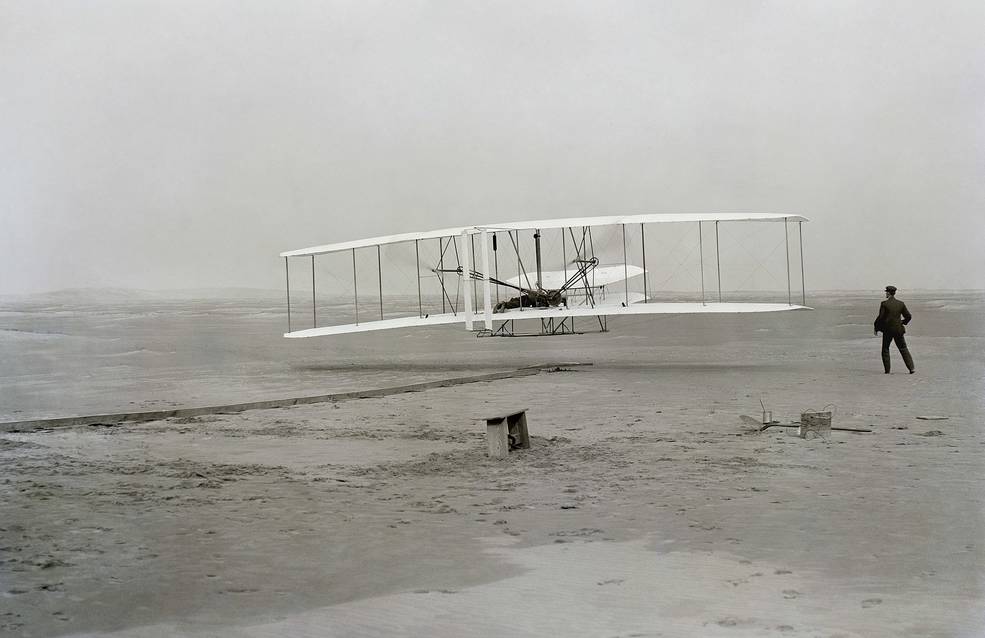
After several unsuccessful attempts, on December 17, 1903, at Kill Devil Hills near Kitty Hawk, North Carolina, Orville Wright completed the first powered flight of a heavier-than-air aircraft known as the Wright Flyer. The flight lasted just 12 seconds, traveled 120 feet, and reached a top speed of 6.8 miles per hour. An amazing feat for its day, one of the five people to witness this historic first flight snapped a photograph of the event. The brothers completed three other flights that day, taking turns piloting, the longest traveling 852 feet in 59 seconds. The highest altitude reached in any of the flights was about 10 feet.
Throughout their journey, the Wright Brothers’ passion, work ethic, and discipline were unmatched. They designed their own customized wind tunnels to rigorously test hundreds of model wings and aircraft components. Unlike other early flight pioneers, they focused intensely on developing highly practical pilot control techniques like wing-warping and a movable rudder connected by wires. The brothers also designed and built a revolutionary lightweight gas engine from scratch specifically capable of sustaining powered flight, unlike previous attempts.
Within a remarkably short span of just five years, the Wright Brothers progressed rapidly from uncertainly hopping above North Carolina sand dunes to confidently piloting complete circles above towns and cities in Ohio and Europe. The brothers even founded their own successful aircraft manufacturing company to produce multiple models of their flyers. As news spread worldwide of the Wright Brothers’ stunning achievement, they gained international celebrity status seemingly overnight. Yet the modest pair remained firmly grounded and humble despite their sky-high fame.
At the heart of the Wright Brothers’ story lies that quintessential American spirit of tenacity, ingenuity, and perseverance. A pair of mere bicycle mechanics and high school dropouts from Ohio achieved what government-funded scientists around the world had failed to do for decades. And they pulled off this monumental feat through self-education, hard work, creativity, and perseverance. Even after countless failed flight attempts that would have dissuaded lesser inventors, they never lost focus on their ultimate dream of flying. This sibling partnership shows just how far shared camaraderie, trust, and friendly competition can push us to achieve the seemingly impossible.
So next time you buckle your seatbelt aboard a modern commercial jet and effortlessly soar miles above the earth at nearly the speed of sound, take a moment to think of Wilbur and Orville. Their humble but dogged dedication forever made these miraculous flights possible for millions globe wide. Those two ingenious bicycle makers from Dayton taught us that with enough perseverance and imagination, even the sky is no longer the limit. The Wright Brothers’ journey from crashing homemade gliders to piloting the first successful airplane reminds us that through passion, grit, and focus, we can always take flight and defy expectations.
Well, I sincerely hope you enjoyed this brief homage to the pioneering Wright geniuses! Their quintessential underdog story is an uplifting American tale of vision, brotherly bonding, and perseverance through countless challenges. Please let me know if you ever want me to dive into any other historic American innovators, inventors or adventurers that intrigue you! I’m always itching to learn more about the figures that fueled our nation’s scientific progress. The Wrights were just getting us off the ground!
Stay curious, keep exploring.
 I was thinking about...