
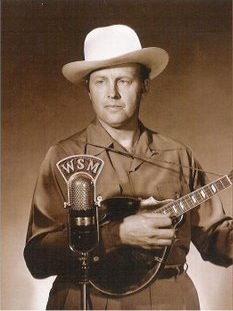
I was thinking about…The Story of Bill Monroe and His Mandolin
By Andy Lee
I was thinking about the origins of bluegrass music, the high-energy American genre pioneered by musical innovator Bill Monroe. With its fast-paced rhythms, emotional high lonesome vocals and incredible instrumental solos, bluegrass blends old-time string band traditions with blues and jazz influences into something entirely new. But how did Bill Monroe come to invent this uniquely American sound?
Bluegrass has its roots in the Appalachian Mountain regions of the southern United States. Immigrants from Ireland, Scotland and England brought instruments like the fiddle and repertoire like jigs and reels that evolved into what was known as old-time mountain music. The banjo traditions of enslaved Africans combined with Celtic fiddle tunes, church hymns, and blues to create a sound distinctive to the rural American south in the early 20th century.
Bill Monroe was born in 1911 in Rosine, Kentucky, right in the heart of this region. His family had a strong musical heritage – both of Monroe’s parents sang and played various string instruments like guitar, fiddle, and mandolin. Young Bill and his brothers Birch and Charlie were taught traditional folk and mountain music from a young age. Bill in particular was drawn to the mandolin, an eight-stringed instrument descended from the European lute.
After his mother and father passed away when he was still a teenager, Bill and his brothers Birch and Charlie began making music professionally at local barn dances and on radio stations. In 1938, Bill Monroe formed his own band, naming them the Blue Grass Boys after his home state of Kentucky, nicknamed the “Bluegrass State”.
Monroe’s high lonesome tenor voice perfectly suited the melancholy ballads and soaring harmonies of old-time Appalachian music. And his mandolin playing was unlike anything heard before – dazzlingly fast and intricate. He developed an emotive, bluesy style that came to define the “high and lonesome” sound of bluegrass music.
Monroe innovated the mandolin as a lead instrument in country music. He modified the standard way it was tuned so he could play more chords and faster melodic runs, bringing the mandolin to the front of the entire band’s sound. The mandolin now played off the fiddle and guitars in propulsive, driving rhythms.
In 1945, Monroe and the Blue Grass Boys signed with Columbia Records, recording popular songs like “Mule Skinner Blues” and “Blue Moon of Kentucky”. Their music incorporated old mountain string band traditions with Monroe’s unique mandolin stylings and vocals. He is credited with inventing the entire bluegrass genre this way.
Over the years, Monroe assembled incredible musicians in the Blue Grass Boys. Guitarists like Lester Flatt and Earl Scruggs helped shape the classic bluegrass interplay between instruments – mandolin, banjo, fiddle, guitar, and bass. Their rapid solos and stage energy brought excitement to audiences not used to such fiery acoustic music.
Earl Scruggs in particular revolutionized the five-string banjo with his rapid three-finger picking style, forever after known as “Scruggs Style”. It cemented the banjo as a leading voice in bluegrass music. This combination of mandolin, banjo, fiddle, guitar, and upright bass forms the core of all bluegrass bands today.
In the 1960s and 70s, Monroe’s music influenced folk rock bands like the Byrds to play bluegrass. His influence also led more traditional artists like the Stanley Brothers, Flatt & Scruggs, and the Osborne Brothers to expand the genre by experimenting with modern songs while retaining the core bluegrass sound.
Bill Monroe continued recording and touring well into the 1980s and 90s, occasionally reuniting with old bandmates for collaborations. He remained the undisputed “Father of Bluegrass” up until his death in 1996 at age 84. Monroe set the standard for everything bluegrass is known for – his bluesy mandolin licks, high lonesome vocals, and gathering of incredibly talented band members.
Today, Monroe’s legacy lives on in every bluegrass musician. His rapid mandolin solos, bent notes, and assembling of legendary sidemen like Scruggs created a sound that was revolutionary for its time. Monroe took old-time string band music from the southern mountains and transformed it into a new genre now recognizably American. The driving rhythms and spirited improvisation of bluegrass provide an uplifting link to rural roots and histories. From country to folk and even jam bands, Monroe’s musical invention continues to influence musicians everywhere.
So next time you hear the joyous sounds of a bluegrass tune, think of Bill Monroe – the Kentucky native who grew up playing mountain music and ended up pioneering an entirely new genre. Thanks to his vision, we now have bluegrass music that carries on old traditions while creating something uniquely American. Bill Monroe and his mandolin truly gave birth to bluegrass as we know it.
Bluegrass blossomed from Monroe’s innovation and musical gatherings. Mandolin, banjo, fiddle, guitar, and bass came together in a powerful blend of driving rhythms. High lonesome vocals told stories of rural life. Improvised solos displayed instrumental prowess. This fiery yet acoustic music was new and exciting for American audiences.
Monroe inspired generations of musicians with his fast mandolin licks and soulful singing. Earl Scruggs took the banjo to new heights that forever changed acoustic music. Bill Monroe’s creativity made old-time mountain music into a new sound that came to symbolize America. Whether teams of friends at festivals jamming into the night or Grammy winning artists, bluegrass remains vibrant and full of life.
At bluegrass festivals from Appalachia to California, Monroe’s legacy echoes through the musicians carrying on traditions born in rural America. Mandolin players try to match Monroe’s signature speed and ornamentation. Banjo pickers play Scruggs’ rapid rolls. Singers emulate Monroe’s high lonesome tenor. Impromptu jams break out as bluegrass players join together to play the old standards.
Bill Monroe passed away in 1996, but his musical contribution lives on. His energy and creativity took string band music from the hills of Kentucky and turned it into a uniquely American sound. Every mandolin run pays tribute to the musical innovator who changed acoustic music forever. Monroe and the Blue Grass Boys turned homegrown mountain music into an inspiring art form that remains vibrant today. For that, he will always be the father of bluegrass.
Stay curious, keep exploring.
 I was thinking about...