
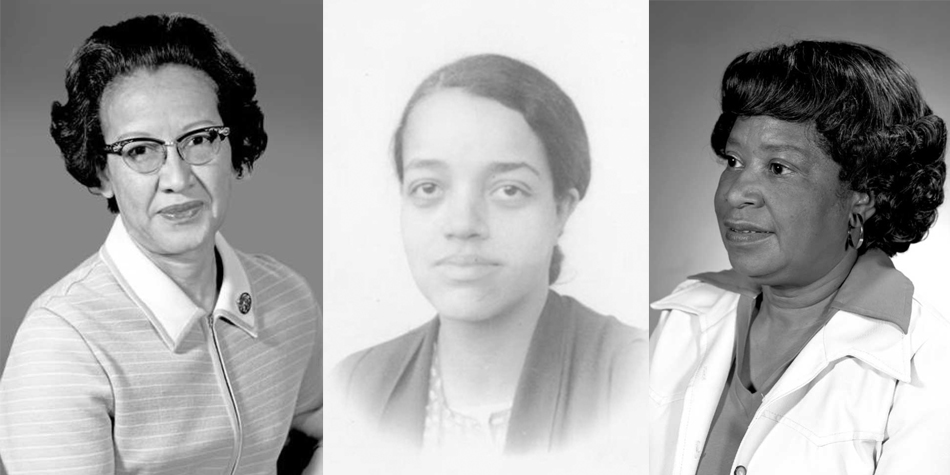
Katherine Goble Johnson, Dorothy Vaughan, and Mary Jackson
I was thinking about…The Pioneering Women of NASA
By Andy Lee
I was thinking about…the untold stories of the groundbreaking women who launched us into space.
When Neil Armstrong and Buzz Aldrin took their historic first steps on the surface of the moon in 1969, an estimated 600 million people watched in awe as the impossible became reality. But far fewer know the stories of the bold women whose unseen contributions were essential to launching humans into the cosmos.
Though the heroic icons of NASA’s early space race were men, an entire constellation of pioneering women scientists and engineers broke barriers behind the scenes. Their work propelling rockets, calculating complex trajectories, and pushing technology forward was indispensable.
In 1953, mathematician Katherine Johnson joined NASA’s Langley Research Center as part of the “West Area Computing” unit, made up entirely of African American female mathematicians. Labeled as “computers,” these women spent years performing critical orbital mechanics and trajectory calculations completely by hand.
Johnson quickly stood out for her extraordinary prowess with analytical geometry. When NASA adopted electronic IBM computers in 1962 for missions like John Glenn’s orbital flight, he insisted Johnson double check their computations personally. “Get the girl to check the numbers,” Glenn famously said. Johnson’s impeccable calculations underpinned milestones like Alan Shepard’s 1961 suborbital flight and the 1969 Apollo 11 moon landing.
Equally brilliant was Mary Jackson, who began her NASA career in 1951 in a segregated unit. She specialized in aeronautical research before transferring to become NASA’s first black female engineer in 1958, despite laws banning black students from white schools. Jackson paved the path for women aeronautical engineers at NASA.
Meanwhile, aviator Geraldyn “Jerrie” Cobb became the first woman to pass astronaut testing in 1959. Turning down honorific titles, she sought an actual astronaut position. Thirteen other talented women soon passed the same brutal physical and psychological tests as male astronaut candidates in the privately-funded Mercury 13 program. Though they matched or exceeded the “Mercury 7” men selected by NASA, the space agency refused these women without providing explanation or opportunity to formally apply. It would be over 20 years until NASA chose the first American woman astronaut in 1978.
From navigating slide rules to pushing the boundaries of aeronautics and astronautics, these pioneering women epitomized the right stuff decades before the public recognized their monumental contributions. Their battle to prove gender did not determine ability laid vital groundwork.
After Mary Jackson’s promotion, more Black women mathematicians rose into aeronautical engineering roles, including Christine Darden who became an expert in supersonic flight and shockwave physics. Katherine Goble (Johnson), Dorothy Vaughan, Mary Winston Jackson and others featured in the book and film Hidden Figures finally began receiving acclaim in the 2010s, though dozens of their female colleagues equally deserve recognition.
We cannot separate the iconic images of Apollo rockets launching from the Earth without these women’s equations guiding the way. Their tireless work, often in the face of discrimination, discrimination, epitomized the human drive to understand and explore. Though hidden from history books, their daring spirit propelled us into space.
So, as we reflect on reaching milestones like the moon landing, let’s remember those who dared to envision the impossible and had the wisdom to know our potential transcends gender and race. Though few walk in fame’s light, many more hands deserve credit for lifting humanity skyward. Here’s to pioneers named and unnamed alike! Their legacy propels us ever upward.
Stay curious, keep exploring.
These thoughts are just the tip of the iceberg! Dive deeper into a world of fascinating stories with my book, ‘I Was Thinking About…’
I Was Thinking About… https://a.co/d/f3h3ro1
 I was thinking about...