
I was thinking about… America’s Oldest City: Discovering the Hidden History of St. Augustine, Florida
By Andy Lee
Upon researching U.S. history, it’s easy to default to thoughts of renowned locations like Philadelphia, Boston, or New Orleans. Yet, the designation of the oldest continuously occupied city in the United States belongs to an unassuming gem on the northeast coast of Florida: St. Augustine. Established in 1565 by Spanish explorer Pedro Menéndez de Avilés, St. Augustine brims with a past that’s palpably alive in its cobblestone streets, enduring forts, and grand Spanish colonial architecture.
From historical accounts, stepping into St. Augustine seems akin to journeying back in time. The old city is said to paint a vibrant tableau of history. Right in the heart of St. Augustine, the Castillo de San Marcos, reportedly the oldest masonry fort in North America, stands as a vivid symbol of the city’s rich legacy. Completed in 1695, this fortress played a crucial role in asserting Spanish sovereignty over the New World for over a hundred years. Its star-shaped design and structure, built from local coquina stone (a kind of shell stone), appear to have withstood the test of time and various assaults, becoming a monument to resilience and St. Augustine’s enduring spirit.
The city’s architecture provides another lens into its history. Reports tell of the Gonzalez-Alvarez House, or “The Oldest House,” which offers insight into the everyday lives of early St. Augustine residents. It presents a treasure trove of artifacts and evolving architectural styles that reflect the city’s diverse line of rulers. The St. Augustine Cathedral, a notable example of Spanish Mission architecture, has reportedly been the city’s religious hub since the late 18th century.
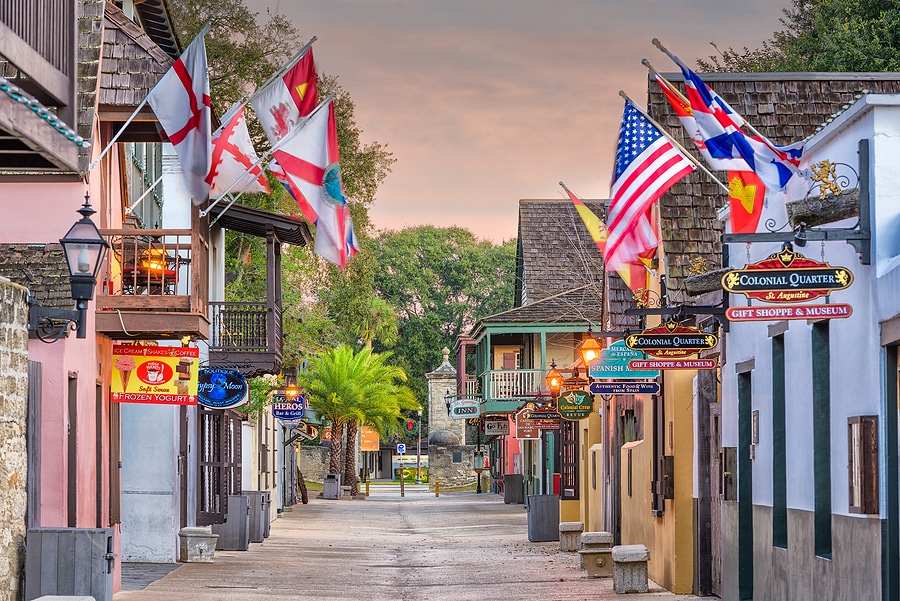
St. Augustine’s past is also etched into its streets. The city’s historic district features Aviles Street, documented as America’s first platted street. This avenue is renowned for its art galleries, shops, and bistros, all housed in vibrant colonial-era buildings. Accounts tell of an almost magical atmosphere that envelops the street at night, under the warm glow of lamps reflecting off cobblestone pathways.
Food culture in St. Augustine mirrors its eclectic history. From research, it appears that a culinary journey through this city is a gastronomic exploration of its past. Restaurants serve dishes like Minorcan clam chowder, a tribute to the Minorcan migrants who settled in St. Augustine in the late 18th century. The influence of Spanish heritage is also apparent, with many menus featuring Spanish tapas and Sangria.
No account of St. Augustine’s history seems complete without a mention of the St. Augustine Lighthouse & Maritime Museum. Towering at 165 feet, this lighthouse has guided mariners since 1874. For those brave enough to climb its 219 steps, the reward is reported to be an unmatched panorama of the city and surrounding areas. The adjacent museum tells the tale of St. Augustine’s maritime history, complete with narratives of shipwrecks, pirates, and the city’s role in naval warfare.
Through research, it becomes apparent that the history of the United States extends beyond the confines of the original thirteen colonies. St. Augustine is a potent reminder of our past, weaving together cultures, continents, and centuries. This city is seen as a historical treasure, a hidden jewel resting on the edge of the Sunshine State. Investigating St. Augustine from afar feels like a virtual journey through time, an adventure into the narratives that have influenced the course of America.
For those who find joy in exploring the breadth and depth of American history, it might be worthwhile to consider delving into St. Augustine, Florida, even from a distance. The wealth of available resources can help you weave together a narrative as colorful and diverse as the city itself. And who knows? This journey of discovery might just inspire a future trip to experience St. Augustine in person. It is definitely on my list of cities to explore.
Although St. Augustine’s stories echo from a past we can’t physically touch, they leave traces for us to follow, traces that help us comprehend the rich, multi-layered history that lies at the very foundation of the United States. So, I was thinking, isn’t it time to uncover the hidden historical threads of St. Augustine, Florida? After all, every city has a story to tell, and this one’s is truly one for the ages.
Stay curious, keep exploring.
 I was thinking about...