
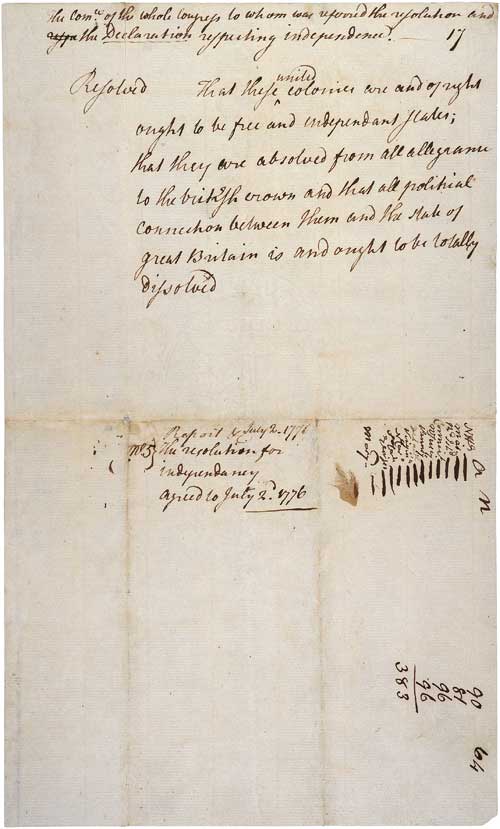
The document seen here shows the vote on the Lee Resolution — the affirmative votes of 12 colonies are listed at the right.
I was thinking about…
The Underappreciated Role of the Lee Resolution
By Andy Lee
The Lee Resolution! Now, that’s a piece of history that doesn’t get nearly as much attention as it should, considering how it essentially laid the groundwork for the creation of the United States. Grab a seat, and let’s dive into this fascinating story from the Revolutionary era.
First off, let’s set the stage a bit. It’s 1776. The American colonies had been simmering with resentment against British rule for quite some time. Tensions were running high after years of “taxation without representation” with recent events such as the Boston Tea Party of 1773 when colonists dumped 342 chests of British tea (valued at approximately $1.7 million in today’s currency) into the harbor. It has been referred to as being the ‘strong brew’ of dissent that laid the groundwork for Lee to propose the world-shattering idea. The Continental Congress, the body of representatives from the thirteen colonies, was in session, wrestling with the monumental question of what to do about this increasingly untenable relationship with Britain.
Between 1774 and 1776, the Continental Congress met in two sessions, primarily to address the increasingly strained relationship with Britain. During the First Continental Congress in 1774, the idea of independence was still a fringe sentiment. The delegates were more focused on figuring out ways to get Britain to redress their grievances.
Fast forward to the Second Continental Congress in 1775, the mood had shifted considerably, especially after the Battles of Lexington and Concord. They were the first military engagements of the American Revolutionary War, marking a point of no return.
Now, into this intense situation steps Richard Henry Lee, a delegate from Virginia. On June 7, 1776, he presented a resolution that was pretty radical for the time. At this point many delegates were ready for such a radical change. Let’s look at what it said:
“Resolved, That these United Colonies are, and of right ought to be, free and independent States, that they are absolved from all allegiance to the British Crown, and that all political connection between them and the State of Great Britain is, and ought to be, totally dissolved.”
Well, talk about dropping a bombshell, right? This was the first formal proposal to cut all ties with Britain, and it’s hard to overstate just how revolutionary (no pun intended!) this idea was.
However, the Congress didn’t leap to a decision straight away. They debated it for a few days, and on July 2, 1776, they cast their votes.
The vote that day was momentous. Just think about it for a second. These men weren’t just deciding to break away from one of the most powerful empires of the time, but they were also laying the foundation for what would become one of the most influential nations in the world. Can you imagine the tension in the room when they cast their ballots?
The result? Affirmative! Twelve of the thirteen colonies voted in favor of the resolution. New York abstained initially, not because they were against independence, but because their delegates hadn’t yet received permission to vote for it. But don’t worry, they came around a bit later and gave their support as well.
The adoption of the Lee Resolution was a game-changer. It officially marked the colonies’ decision to pursue independence from Great Britain. This bold stance laid the foundation for what would come next: the drafting of the Declaration of Independence. The Lee Resolution served as the legal authorization for it, providing a clear direction and purpose. The Declaration was, in essence, an explanation to the international community and a justification for this audacious move. It’s quite possible that without the Lee Resolution, the Declaration could have looked quite different or even been delayed.
But it’s also interesting to think about the work that followed the vote. You see, the Congress formed a “Committee of Five,” including Thomas Jefferson, John Adams, Benjamin Franklin, Roger Sherman, and Robert R. Livingston, to draft the Declaration. You might wonder why Lee, who had proposed the resolution, wasn’t on the committee. It seems he had to leave Philadelphia shortly after presenting his resolution to care for his sick wife.
Jefferson was chosen to write the first draft, and it was a daunting task. The Declaration was more than just a statement of independence—it was a justification of revolution, explaining why the colonies had chosen to separate from Britain. It was essentially a 28-count indictment against King George and the British crown for the way they had treated the colonies. And, of course, it enshrined the principles that would guide the new nation. Without the Lee Resolution, Jefferson might not have had such clear direction when drafting the document.
As we’ve seen, the Lee Resolution was pivotal in the American journey towards independence. Its timely introduction and adoption set the course for the nation’s future. If these events had happened even slightly differently—say, if the resolution hadn’t been passed, or if it had been delayed—the entire trajectory of the Revolutionary War could have been different. And that would have fundamentally altered the history of the United States and, indeed, the world.
There’s a ripple effect to history, isn’t there? The actions taken on one day can reverberate through centuries. The Lee Resolution is one such example. It’s proof of the power of decisive action at critical moments and to the transformative effects of daring, revolutionary ideas. Fascinating stuff, wouldn’t you say?
 I was thinking about...