
I was thinking about…
The Battle of Gettysburg: A Turning Point in the American Civil War
By Andy Lee
The Battle of Gettysburg, a conflict seared into the nation’s collective memory, serves as a stark reminder of the devastating cost of war and the resilience of the human spirit. Fought in the small town of Gettysburg, Pennsylvania, from July 1 to July 3, 1863, this three-day clash was the bloodiest battle of the American Civil War, yielding approximately 51,000 casualties.
The battle began when Union and Confederate forces collided in the farmlands of southern Pennsylvania. Under the strategic command of General George Meade, the Union’s Army of the Potomac squared off against the Confederate Army of Northern Virginia, led by the renowned General Robert E. Lee. Lee, having achieved significant victories in the war thus far, aimed to carry the momentum into Union territory, specifically targeting Harrisburg, the state capital. A large-scale victory in the North was envisioned as a demoralizing blow to the already war-weary United States, possibly prompting calls for peace.
But history had a different narrative to offer. The Battle of Gettysburg, in an ironic twist of fate, became the site of a significant Union victory, marking a turning point in the Civil War. It effectively halted the Confederate invasion of the North and reinvigorated the Union army and civilians, providing a much-needed morale boost.
The opening day of the battle saw the Confederate forces gaining an upper hand. Union soldiers found themselves retreating through the streets of Gettysburg, pursued by relentless Confederate soldiers who seized the opportunity to loot homes and cellars for valuables, clothing, and food. However, this initial success did not forecast the final outcome of this bloody encounter.
As the battle raged on, the tide turned in favor of the Union. By the second day, Union forces had established a strong defensive line, known as the “fishhook” due to its shape, across Cemetery Hill, Cemetery Ridge, and Little Round Top. Intense fighting ensued at various locations, but the Union lines held against Confederate assaults.
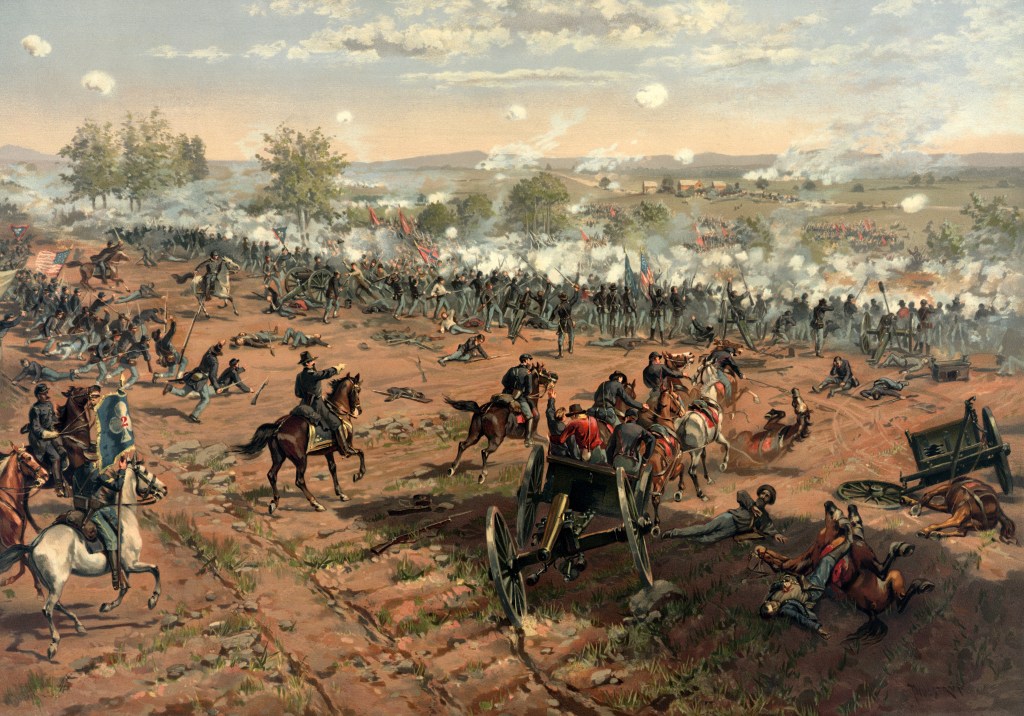
The climax of the battle, and one of its most iconic moments, came on its final day: July 3, 1863. This day witnessed Pickett’s Charge, a daring infantry assault named after one of its leaders, Confederate General George Pickett. A force of 15,000 Confederate soldiers advanced over open fields towards the Union center at Cemetery Ridge. Despite the courage displayed by the Southern soldiers, the attack ultimately failed. The Confederates were met with a storm of artillery and rifle fire, causing devastating losses and failing to break through the Union lines.
The Union’s success at the Battle of Gettysburg, coupled with the victory at Vicksburg on the Western Front, marked a pivotal shift in the course of the Civil War. It was a significant defeat for Lee and the Confederacy, thwarting their invasion of the North. The events at Gettysburg were a testament to the resilience and determination of the Union forces, changing the trajectory of a conflict that would continue to rage for almost two more years.
The Battle of Gettysburg is etched in the annals of American history as a symbol of sacrifice and tenacity. Its impact resonates to this day, a reminder of the price of freedom and the indomitable spirit of those who fight for it.
“I Was Thinking About…” where curiosity meets history.
Curious for more? My book ‘I Was Thinking About…’ uncovers even more hidden treasures of history, people, and places.
Grab your copy today:
 I was thinking about...