
I was thinking about…
From Spavinaw to Yankee Stadium: The Incredible Story of Mickey Mantle
By Andy Lee
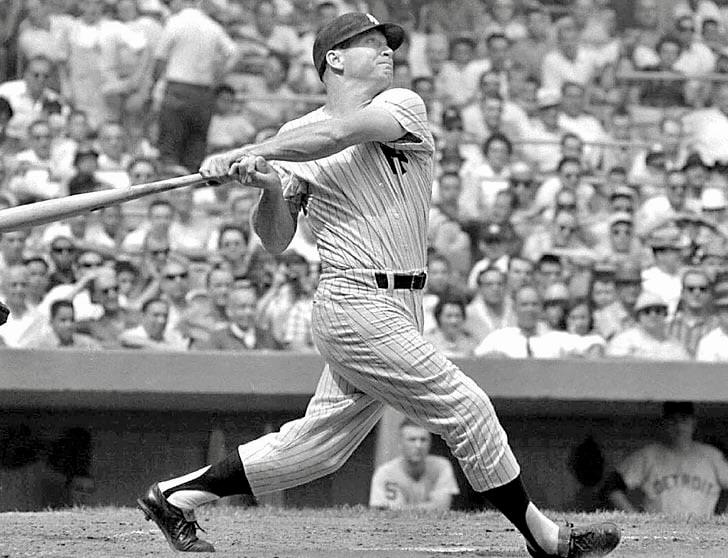
Mickey Mantle, often regarded as the most significant Oklahoman in Major League Baseball, etched his name into the annals of the sport with a remarkable eighteen-year career as a switch-hitter for the New York Yankees. Born on October 20, 1931, in Spavinaw, Oklahoma, Mantle grew up in Commerce and gained the monikers “Commerce Comet” and “The Mick.” His impact on the game was undeniable, as he left a lasting legacy with his extraordinary achievements, culminating in his induction into the National Baseball Hall of Fame in 1974.
Mantle’s introduction to baseball came at an early age. He was named after Mickey Cochrane, the renowned catcher for the Philadelphia Athletics and a Hall of Famer, who was idolized by Mickey’s father, Elvin Mantle. Elvin, an amateur pitcher known for his blazing fastball, also toiled in the lead and zinc mines of northeastern Oklahoma. It was Elvin who instilled in his son the art of switch-hitting, using tennis balls thrown by both his right-handed father and left-handed grandfather.
In 1949, on the night of his high school graduation from Commerce High School, Mantle showcased his talent while playing for the Baxter Springs Whiz Kids in a Ban Johnson League game against Coffeyville. It was during this game that legendary Yankees scout Tom Greenwade first laid eyes on the young Mantle. Despite making a few errors at shortstop, Mantle’s impressive performance, which included two home runs and two singles, caught Greenwade’s attention. Just two days later, in a car after a rain-delayed game, Greenwade offered Mantle a thousand-dollar bonus to sign with the Yankees.
Mantle’s ascent continued as he progressed through the minor leagues, displaying his exceptional hitting prowess. In 1949, he hit an impressive .313 for the Independence team in the K-O-M League. The following year, while playing for Joplin in the Class C Western Association, Mantle maintained a scorching batting average of .383, along with twenty-six home runs and 199 hits. His performance caught the attention of the Yankees, who called him up to their pre-camp school in February 1950. However, Mantle faced a hurdle as he lacked the funds to make the trip to Phoenix, Arizona. To his surprise, the Yankees discovered his predicament and promptly wired him the necessary funds.
During the spring of 1950, Mantle joined the Yankees as a shortstop, a time when the legendary Joe DiMaggio still patrolled center field. However, Mantle’s exceptional skills soon propelled him into the outfield. In spring training, he showcased his talent, hitting a remarkable .402 with nine home runs. Mantle’s rapid development perplexed his manager, Casey Stengel, who admitted his confusion in an interview with Sport magazine. Stengel acknowledged that Mantle was not yet a fully polished outfielder, suggesting that he should have spent a year in Triple-A. However, Stengel couldn’t deny Mantle’s undeniable abilities, labeling him a big-league hitter and baserunner from the outset.
As Mantle’s career progressed, he solidified his place in Yankees history. In 1951, he replaced the retiring DiMaggio as the team’s regular center fielder, batting .267 with thirteen home runs in ninety-six games. He also made his first appearances in the World Series that year, laying the groundwork for his postseason heroics. In 1952, Mantle truly shone on the World Series stage, batting .345 with two home runs during the Yankees’ victory over the Brooklyn Dodgers.
Throughout his illustrious eighteen-year career, Mantle accumulated an impressive array of accomplishments. He was named the Most Valuable Player in the American League three times and received the honor of being selected to twenty All-Star teams. In 1956, Mantle achieved the coveted American League triple crown, leading the league with a remarkable .353 batting average, fifty-two home runs, and 130 runs batted in (RBIs). It was during that season when Mantle unleashed a prodigious 565-foot home run at Washington’s Griffith Stadium, forever etching the term “tape measure” home run into baseball lore.
Mantle’s power and prowess at the plate were legendary. On five occasions, he came tantalizingly close to becoming the first player to hit a fair ball out of Yankee Stadium, a feat that only added to his mystique. His dominance extended to the grand stage of the World Series, where he excelled under pressure. Mantle holds numerous World Series records, including forty RBIs, forty-two runs scored, forty-three walks, twenty-six extra-base hits, and 123 total bases. In twelve World Series appearances, he left an indelible mark by slugging an all-time record of eighteen home runs.
One of Mantle’s most memorable seasons came in 1961, the year when his teammate Roger Maris famously surpassed Babe Ruth’s single-season home run record of sixty. Mantle played a pivotal role by hitting fifty-four home runs himself, often batting behind Maris in the lineup. Many believed that pitchers were more inclined to challenge Maris, leading to Mantle receiving favorable pitches as a result. Their tandem pursuit of the record captivated fans across the nation and added to the legend of Mickey Mantle.
Beyond his on-field accomplishments, Mantle was also known for his off-the-field escapades and camaraderie with teammates. Alongside second baseman Billy Martin and pitcher Whitey Ford, he was part of a trio renowned for their practical jokes and mischievous behavior. One story that epitomized their hijinks involved Mantle attempting to evade curfew by climbing into a hotel room through a window. However, Martin, displaying his own mischievous streak, promptly shut the window, leaving Mantle stranded outside and inadvertently damaging his expensive suit in the process.
Even after his retirement from baseball in 1968, Mantle remained connected to the sport. He briefly served as a coach for the Yankees, providing guidance to the next generation of players. Additionally, he found success as a baseball broadcaster, sharing his insights and experiences with fans across the country. Mantle also pursued business ventures, including working for a Dallas insurance company and co-owning Mickey Mantle’s Restaurant in New York City.
Tragically, Mickey Mantle’s life was cut short when he passed away on August 13, 1995, in Dallas, Texas. Despite his untimely departure, his impact on the game of baseball remains unparalleled. His legacy as one of the greatest players to grace the diamond endures, solidifying his place among the all-time greats in the National Baseball Hall of Fame. Mickey Mantle’s combination of power, speed, and charisma captivated fans throughout his career, and his name will forever be synonymous with the rich history of the New York Yankees and the sport of baseball.
“I was thinking about…” – where curiosity meets history.
Curious for more? My book ‘I Was Thinking About…’ uncovers even more hidden treasures of history, people, and places.
Grab your copy today:
 I was thinking about...