
I was thinking about…
June 25, 1876: George Armstrong Custer, Sitting Bull, and the Battle of Little Bighorn
By Andy Lee
George Armstrong Custer was a United States Army officer and cavalry commander in the Civil War and the Indian Wars. Custer graduated from the U.S. Military Academy at West Point and his audacious and daring personality led him to rise quickly in the ranks during the Civil War. Major General George McClellan appointed him at just twenty-three years old as brigadier general in charge of the Michigan cavalry brigade, also known as the “Wolverines”.
Custer’s prominence continued to grow and by 1864, he was leading the Third Cavalry Division in General Philip Sheridan’s Shenandoah Valley campaign. His role in the Civil War culminated with his pursuit of General Robert E. Lee’s retreating army, and Custer himself received the Confederate flag of truce when Lee surrendered at Appomattox Court House.
Following the Civil War, Custer was assigned to the western frontier, where his mission was to impress and intimidate hostile Plains Indians with a display of U.S. military power. The discovery of gold in the Black Hills in 1874, however, led to an influx of white miners into territory that had been ceded to the Sioux under the second Treaty of Fort Laramie in 1868. The tensions culminated in the U.S. Army preparing for battle when many Sioux failed to return to their reservations by the ordered date in January 1875.
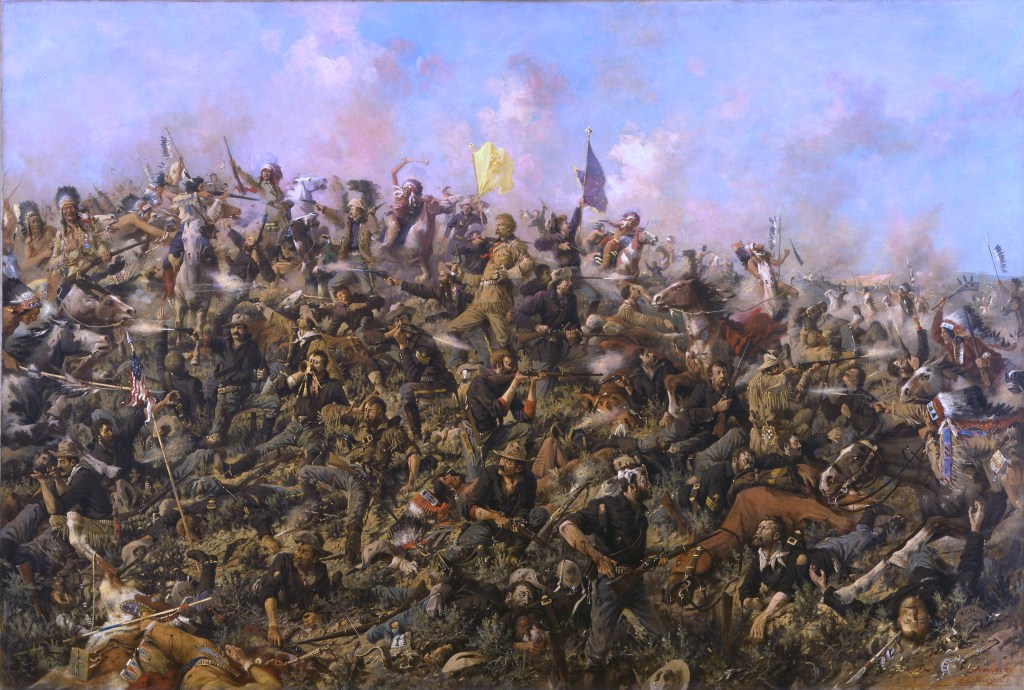
In May 1876, Lieutenant Colonel Custer led the 7th United States Cavalry Regiment on an expedition to locate and defeat tribes resisting under the leadership of Chief Sitting Bull. The plan was to trap Sitting Bull in the Little Big Horn area. However, against Brigadier General Alfred H. Terry’s orders, Custer decided to launch an immediate attack upon finding Sitting Bull’s camp. Custer underestimated the strength of his enemy, and his decision to divide his forces backfired, leading to a quick and devastating defeat known as “Custer’s Last Stand”.
Custer, his brother, and nearly a third of the 7th Cavalry perished at Little Big Horn. In the aftermath, the U.S. public was galvanized against the Indians, and more federal troops were sent into the Black Hills.
Sitting Bull, a key spiritual and political leader among the Native Americans, escaped to Canada in 1877 but returned to the U.S. four years later due to the brink of starvation faced by his supporters. In the years that followed, Sitting Bull fought against the sale of tribal lands under the Dawes Severalty Act and took part in the Ghost Dance Movement—a religious revival among Native Americans that was perceived as a threat by federal authorities. In 1890, an attempt by these authorities to take custody of Sitting Bull led to his death. The story of George Armstrong Custer, the Battle of Little Bighorn, and Sitting Bull is a complex chapter in American history that illustrates the profound conflicts and misunderstandings between the U.S. government and Native American tribes during this era.
Keep your curiosity alive and continue to explore the hidden gems that await your discovery. Remember, history is not just a collection of facts. It’s a tapestry of human stories, triumphs, and challenges that connect us to our past and shape our future. So, keep thinking, keep questioning, and keep discovering. Together, let’s unravel the mysteries of our world, one story at a time.
“I was thinking about…” – where curiosity meets history.
Curious for more? My book ‘I Was Thinking About…’ uncovers even more hidden treasures of history, people, and places.
Grab your copy today:
 I was thinking about...