
I was thinking about…
The Life and Contributions of Ada Lovelace
By Andy Lee
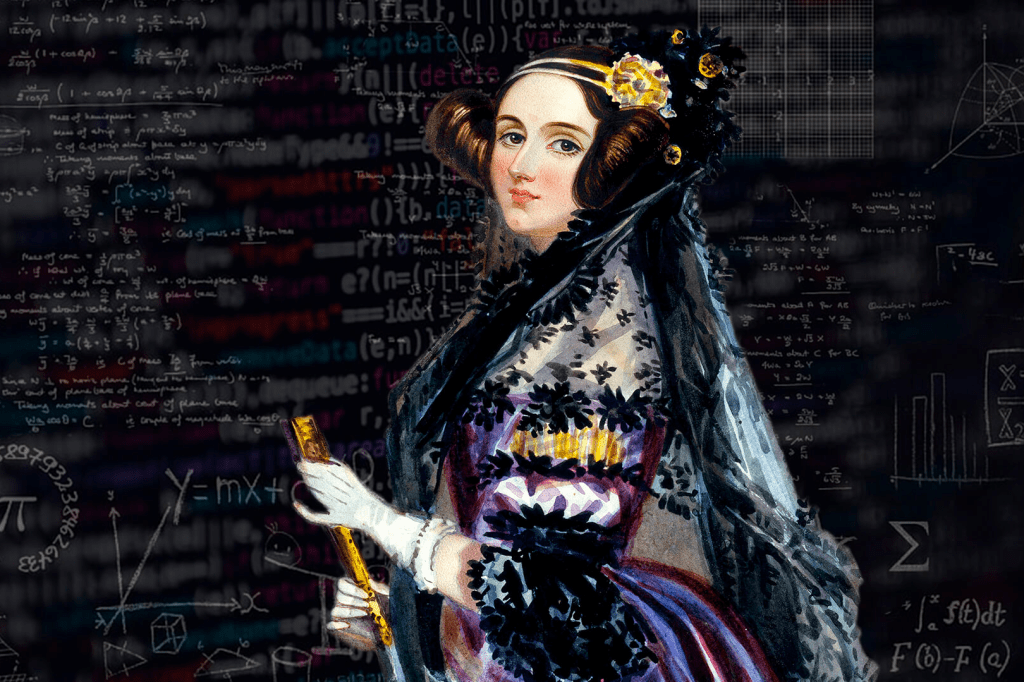
Ada Lovelace, the daughter of the renowned poet Lord Byron, left an indelible mark on the world as the pioneer of computer programming. Her visionary ideas and collaboration with Charles Babbage during the mid-19th century laid the foundation for modern computing and solidified her place in history.
Born Augusta Ada Byron on December 10, 1815, Ada Lovelace grew up surrounded by intellect and creativity. Her mother, Anne Isabella Milbanke, a mathematician herself, nurtured Ada’s interest in mathematics and logic from a young age. Recognizing her daughter’s prodigious talent, Lady Byron ensured that Ada received a well-rounded education, focusing on mathematics and science.
At the age of seventeen, Ada was introduced to Charles Babbage, a mathematician and inventor who is widely regarded as the “father of the computer.” Babbage was working on an ambitious project called the Analytical Engine, a mechanical computing device that was far ahead of its time. Fascinated by Babbage’s invention, Ada immersed herself in its intricacies and began envisioning the possibilities beyond mere calculation.
During her collaboration with Babbage, Ada demonstrated exceptional analytical skills and an ability to grasp the fundamental concepts of the Analytical Engine. She saw the potential for the machine to perform not just numerical calculations but also to manipulate symbols and create complex algorithms. In essence, she recognized the concept of a general-purpose computer.
Ada’s most significant contribution came in the form of an extensive set of notes she wrote about the Analytical Engine. These notes, which included her own elaborations and mathematical examples, detailed an algorithm for calculating Bernoulli numbers. Her algorithm is considered the first ever intended for implementation on a machine and is often regarded as the first computer program.
What set Ada Lovelace apart was her visionary understanding of the Analytical Engine’s capabilities. She saw beyond its mathematical functions and recognized its potential for creating art, music, and even scientific discoveries. Ada’s notes not only included mathematical calculations but also philosophical reflections on the relationship between science, art, and creativity. In many ways, she envisioned the broader implications of computing that would unfold in the decades to come.
Despite her groundbreaking work, the Analytical Engine was never fully realized during Ada’s lifetime. However, her notes, published in 1843, gained attention and sparked interest in the potential of computing machines. Ada’s work remained relatively obscure until the mid-20th century when her contributions were rediscovered and recognized by the computing community.
Today, Ada Lovelace is celebrated as a pioneer in computer science and a visionary thinker. Her insights laid the foundation for the development of modern computers, programming languages, and artificial intelligence. The computer programming language Ada, named in her honor, serves as a testament to her lasting legacy.
Ada Lovelace’s life was tragically cut short at the age of 36 due to cancer. However, her impact on the world of technology and her status as a trailblazer for women in STEM (science, technology, engineering, and math) fields cannot be overstated. Her brilliance, imagination, and dedication to pushing the boundaries of what was possible continue to inspire generations of computer scientists, engineers, and innovators.
As we reflect on the life and contributions of Ada Lovelace, let us remember her as a visionary thinker, a pioneer, and a symbol of the limitless potential of human imagination. Her journey reminds us that great achievements can be born out of collaboration, curiosity, and a relentless pursuit of knowledge.
Join me again soon for more captivating stories that explore the intersection of curiosity and history in “I was thinking about…” Until then, let Ada Lovelace’s legacy inspire you to embrace your own curiosity and boldly venture into uncharted territories of knowledge.
“I was thinking about…” – where curiosity meets history.
 I was thinking about...