
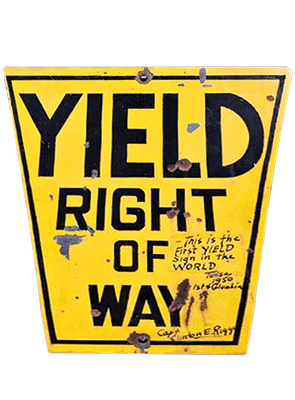
The First Yield Sign – An Oklahoma Original
By Andy Lee
The first yield sign was invented in 1950 by Clinton Riggs, a police officer in Tulsa, Oklahoma. Riggs was looking for a way to improve safety at an intersection that had a high number of accidents. He came up with the idea of a sign that would remind drivers to slow down and yield to traffic that had the right of way.
The original yield sign was a white keystone with the words “Yield Right of Way” in black letters. It was placed at the intersection of First Street and Columbia Avenue in Tulsa. Within a year of its installation, the accident rate at the intersection dropped by 70%.
Within a year of the sign’s posting, accident rates at the intersection dropped dramatically. The sign was so successful that it was soon adopted by other cities around the country. In 1954, the yield sign was added to the Manual on Uniform Traffic Control Devices (MUTCD), which is the national standard for traffic signs.
Here are some additional facts about the yield sign:
- The yield sign is a triangle with an inverted apex.
- The sign is typically placed 150 feet before an intersection.
- Drivers should slow down and yield to traffic that already has the right of way.
- The yield sign is a reminder that we all have a responsibility to share the road.
Today, the yield sign is one of the most common traffic signs in the world. It is used to remind drivers to slow down and yield to traffic that already has the right of way. The yield sign has helped to make our roads safer, and it is a reminder that we all have a responsibility to share the road.
 I was thinking about...